


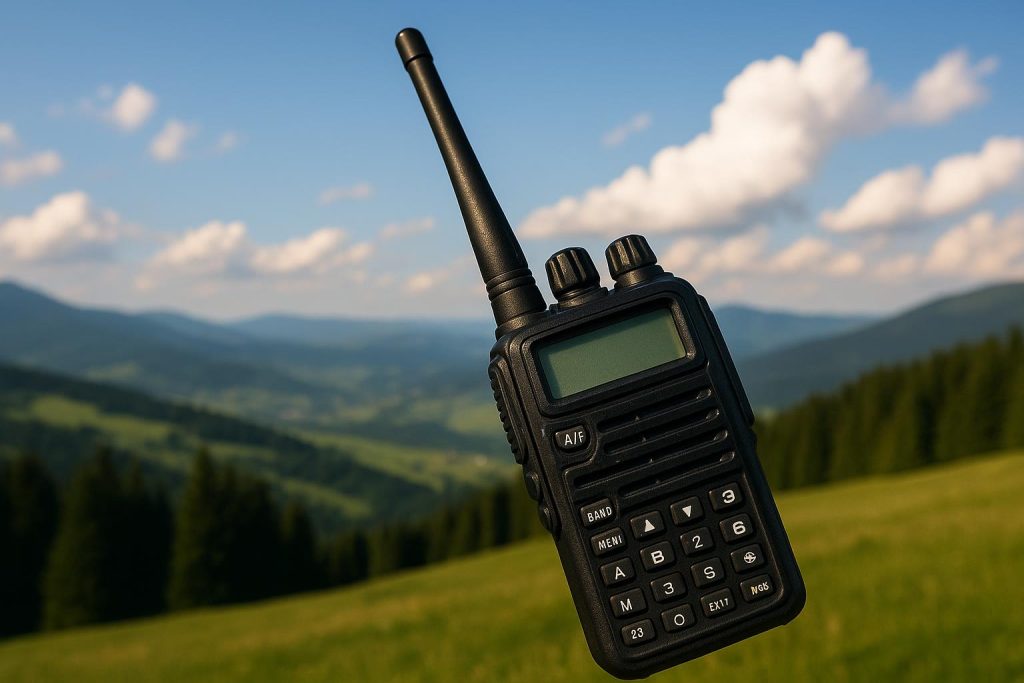
You press the talk button.
“Hey, can you move the equipment to—”
Static.
Someone responds from somewhere across the site:
“…repeat that?”
You try again. Still broken. Still unclear. Now three people are talking at once and nobody actually knows what the message was supposed to be.
Not ideal.
Communication tools are supposed to simplify coordination, not turn every conversation into a guessing game. That’s why choosing the right walkie talkie—especially for long-range use—matters more than most people realize.
Modern push-to-talk radios have evolved far beyond the toy-like devices many remember from childhood. Today’s systems can connect teams across entire regions while still keeping the classic “press and speak” simplicity.
But here’s the catch: not all radios are created equal.
If you’re choosing a long-range communication device, these are the features that truly matter.
Range That Actually Means Something
Let’s start with the obvious question.
How far can the signal travel?
Traditional walkie talkie devices rely on direct radio frequencies, which usually means a few miles of coverage under ideal conditions. Add buildings, hills, warehouses, or city interference and that distance shrinks quickly.
That’s where modern push-to-talk technology changes the game.
Many long-range devices now operate using cellular networks, allowing messages to travel far beyond traditional radio limits. Instead of bouncing signals directly between devices, the transmission moves through network infrastructure and reaches every radio connected to the system.
Result?
Your message can travel across cities—or even nationwide.
Much better than yelling across a parking lot.
Instant Push-To-Talk (Because Waiting Is Annoying)
Speed matters.
One reason teams still rely on a walkie talkie instead of phones is the instant response. There’s no dialing. No ringing. No “please leave a message after the tone.”
You press a button.
You speak.
Everyone hears it immediately.
The best systems transmit voice within a second, keeping communication fluid and natural. That responsiveness is especially valuable in fast-moving environments like logistics operations, construction projects, or large events.
If a device introduces delays, the whole advantage of push-to-talk disappears.
And nobody wants that.
Audio That Cuts Through Noise
Now imagine trying to coordinate on a busy construction site.
Heavy equipment running. Generators humming. Trucks backing up.
If the audio isn’t clear, communication becomes frustrating very quickly.
A high-quality walkie talkie should include strong speakers, noise reduction technology, and microphones capable of isolating voices from background noise.
Clear audio saves time.
More importantly, it prevents costly misunderstandings.
Because “Move the crane” and “Move the crate” are two very different instructions.
Simple Setup (Because Nobody Wants a Tech Project)
One of the biggest reasons radios remain popular is their simplicity.
Turn it on. Press the button. Talk.
That’s the experience users expect from a walkie talkie, even when the technology behind the scenes becomes more advanced.
Modern long-range systems often come preconfigured so teams can begin communicating immediately. No complicated programming. No confusing setup menus.
Good technology should reduce complexity—not create more of it.
Durability: Because These Devices Live Outside Offices
Radios rarely live comfortable lives.
They get dropped. Knocked around. Used in dusty warehouses, outdoor job sites, and unpredictable weather.
So durability matters.
A reliable walkie talkie should feature rugged construction, long battery life, and the ability to handle rough environments without constant maintenance.
If the device fails halfway through a workday, it stops being a communication tool and becomes an expensive paperweight.
Not exactly helpful.
Group Communication (The Real Advantage)
Here’s something phones still struggle to replicate efficiently.
Group communication.
With a walkie talkie, one message reaches an entire team instantly. No calling multiple people. No endless group chats filled with notifications.
Just one voice. One transmission. Everyone informed.
Many modern systems even allow multiple talk groups, letting different teams communicate independently while staying connected through the same network.
For larger operations, that flexibility becomes incredibly useful.
Final Thoughts: The Right Radio Changes Everything
At its core, the walkie talkie remains one of the simplest communication tools ever invented.
Press the button.
Say the message.
Everyone hears it.
What’s changed is the technology behind it.
Today’s long-range radios combine that classic simplicity with powerful network connectivity, allowing teams to communicate across massive distances without complicated systems.
And when coordination matters—whether on a job site, during an event, or in the field—the right features make all the difference.
Because clear communication isn’t just convenient.
Sometimes, it’s essential.