


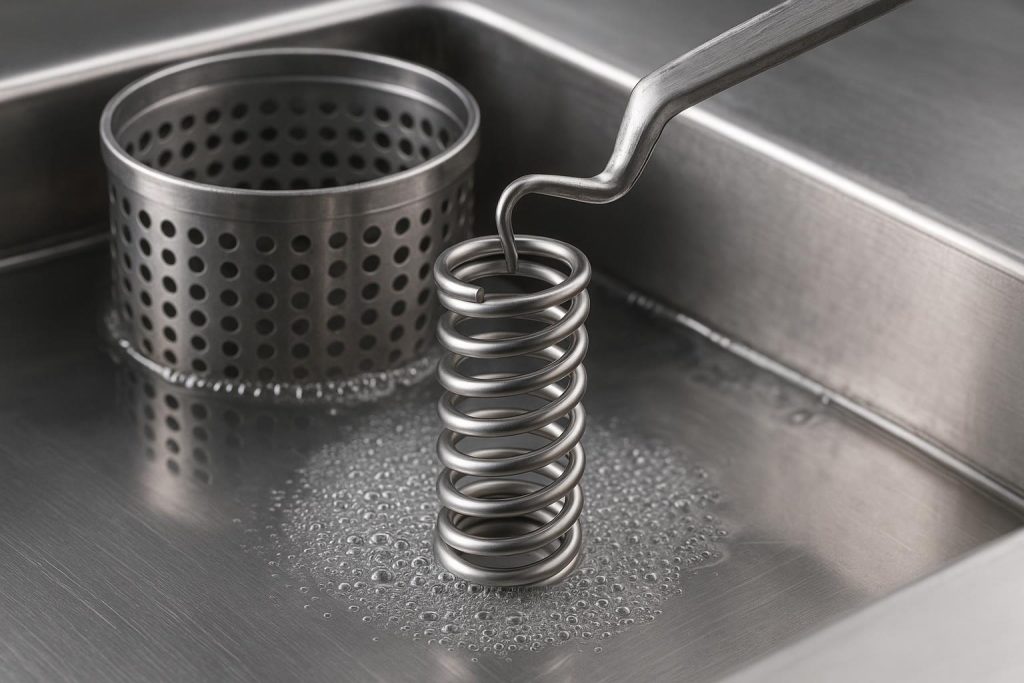
No matter their size, metal springs play a big role in countless parts used in everything from medical devices to aerospace components.
The slightest defect in a spring’s metal surface can shorten its lifespan and lead to catastrophic failure in mission-critical environments. Springs work in roles that demand a flawless surface finish.
Electropolishing improves the performance and durability of metal parts in ways that other finishing methods cannot, with precision and consistency that ensure the highest-quality finish for complex parts across a range of sizes. Electropolishing improves the finish, fit, and function of critical metal parts, such as compression, torsion, and flat springs.
How Electropolishing Works to Optimize Spring Performance
Electropolishing works by immersing parts in a customizable electrochemical bath that gently dissolves a microscopically thin layer of surface material. In the process, imperfections such as microburrs, microcracks, and notches are removed, leaving the part with an ultrasmooth surface and enhanced corrosion resistance.
Metal parts are placed into the bath on carefully designed racks that ensure the electrochemical process is applied consistently across the parts’ surfaces.
By creating a uniform, ultrasmooth surface, electropolishing leaves parts with improved durability, an especially important benefit for springs, which are subjected to rigorous use and repetitive bending, flexing and twisting that can leave areas prone to defects that weaken or even fail.
Why Use Electropolishing for Your Springs
While springs are designed to withstand repetitive compression, tiny imperfections in the metal surface can leave even the most well-designed spring prone to cracking, breakage, erosion, and corrosion.
Such imperfections are a common side effect of wire forming and cutting operations. By eliminating these stress concentrators, electropolishing enables springs to perform more cycles without part fatigue. Electropolishing also removes discoloration left behind by heat treatment, creating a bright, decorative finish while enhancing the material’s corrosion resistance.
A commonly used alloy in spring manufacturing is 17-7 stainless steel, which can develop discoloration and surface roughness during heat treating, detracting from its appearance and degrading its performance. Electropolishing effectively removes this discoloration and leaves springs defect-free, in a passive state, and with 30 times more corrosion resistance than passivation.
Electropolishing vs. Tumbling: Which is More Effective for Critical Metal Springs
For spring manufacturers, choosing the right finishing process is critical. Tumbling is a common method of deburring, but it is risky for springs, which can become distorted or tangled. The risk is even greater for small and delicate springs.
A high-quality electropolishing specialist will employ rack makers on-site who can create custom racking for delicate or especially small parts, ensuring no part-to-part contact and even, consistent electropolishing across all part surfaces.
Electropolishing has the added advantage of reaching tiny, hard-to-access areas that traditional bulk finishing methods often miss.
The Electropolishing Advantage
To take advantage of the superior surface finish electropolishing provides for metal springs, look for a provider that specializes in electropolishing and has worked across industries on a wide range of critical parts and alloys, including stainless steel, music wire, Inconel, and specialty alloys like Elgiloy.
This experience ensures high-quality results, a customized approach to complex or unusual parts, and a quality control process that may include in-house testing and analysis, such as 3D surface profiling.