


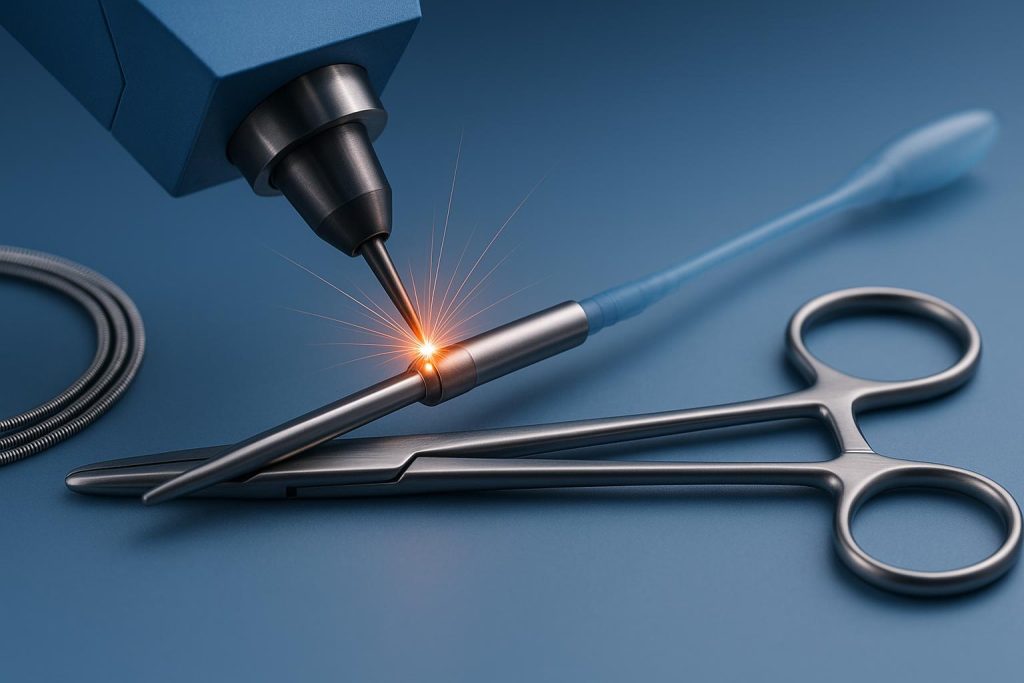
Behind every successful medical procedure is an enormous amount of engineering that most people never see. A surgeon may rely on a tiny instrument for only a few minutes, or a patient may depend on an implant for decades, yet both share one expectation— the device must work exactly as intended, every single time. In healthcare, there is little room for “good enough.”
That is why manufacturers should rely on specialized welding companies that continue to invest in welding technologies that improve precision, reliability, and consistency. Among them, laser welding has quietly become one of the most important building blocks of modern medical innovation.
Medical Welding Precision Isn’t About Manufacturing, It’s About Protecting Lives
In most applications, a weak weld is viewed as a gateway to equipment failure or unexpected downtime. In healthcare, the consequences are not just machine failure, but also a patient’s life or even operator is at stake. Whether it’s a pacemaker, an endoscopic instrument, or a catheter used during a delicate procedure, every connection must perform exactly as designed.
That’s one reason laser welding has become so valuable. Laser Welding Solutions solve the problem of large heat-affected-zones by concentrating its energy exactly where it’s needed. That way, other neighboring surfaces experience very little disturbance. That allows safe welding of condensed and sensitive electronic motherboards, miniature sensors, and other delicate components.
The benefits reach far beyond the factory floor:
- Optimized dependable joints make medical devices safe and efficient
- Minimal heat exposure to sensitive components
- Greater dimensional accuracy for miniature assemblies
- Cleaner, more consistent results across production
For manufacturers, this means fewer compromises during design, and extreme reliability for healthcare professionals.
Building New Devices and Extending the Life of Existing Ones
Laser welding plays two equally important roles in healthcare. The first happens long before a medical device reaches a hospital. During manufacturing, it helps create products that are consistent, reliable, and ready to meet demanding regulatory requirements.
The second often receives far less attention—but it’s just as valuable. Many high-quality surgical instruments, precision tools, and specialized medical assemblies don’t need replacing simply because one area has worn over time. Skilled welders like Micro Weld, Inc. map welding procedure specification to accurately restore and rescue worn out components through carefully controlled Medical Device Welding, returning them to service while preserving their original performance.
That creates important advantages for healthcare organizations and manufacturers alike:
- Reduced replacement costs
- Less material waste
- Shorter lead times
- Better use of valuable equipment
- Greater sustainability across the product lifecycle
Instead of viewing repair as a temporary fix, experienced specialists see it as an opportunity to extend the working life of high-value assets without compromising quality.
The Technology That Helps Medical Devices Keep Getting Smaller, So the Welds
Take a look at today’s medical technology and one trend becomes obvious—everything is becoming smaller, lighter, and more capable. Implantable devices now contain sophisticated electronics inside tiny housings. Surgical tools continue becoming more precise, while minimally invasive procedures depend on instruments that can navigate spaces measured in millimeters.
None of that happens by accident. Because laser welding concentrates energy into a tiny focal spot, it produces deep penetration relative to its width. You get a surprisingly strong joint without needing a large, bulky bead.
Also, it excels at micro-repairs (like filling hairline cracks in molds, tooling, or delicate medical tools) by depositing tiny amounts of material right into the crack without melting the surrounding metal. That is because laser welding can reach down into tight, narrow grooves or deep crevices where physical welding torches (like TIG nozzles) simply won’t fit. As long as the optics have an unobstructed, straight path to the joint, you can weld it.
Today, laser welding supports innovations across applications such as:
- Implantable devices
- Catheters and guide wires
- Endoscopic instruments
- Robotic surgical equipment
- Medical imaging assemblies
As medical technology continues evolving, the ability to manufacture increasingly compact devices without sacrificing strength or reliability becomes even more valuable.
Advanced Materials Demand More than Advanced Equipment
One of the biggest misconceptions in manufacturing is that the machine does all the work. In reality, the equipment is only part of the equation. In medical device manufacturing, repair, and maintenance, material selection is directly tied to biocompatibility, mechanical performance, and long-term patient safety.
Unique welding materials include: Titanium, nitinol, and stainless steel.
For example, each material responds differently to heat. That means successful welding depends on understanding how those materials behave before, during, and after the joining process—not simply pressing a button.
Experienced laser welding specialists routinely work with:
- Titanium alloys
- Nitinol (shape-memory alloys)
- Medical-grade stainless steel
- 3D-printed metal components
- Specialty copper alloys
- Selected engineering polymers
- Dissimilar metal combinations
Matching the welding process to the material helps preserve the properties that made those materials worth choosing in the first place.
Welding Precision Must Align With Proven Quality
Producing a beautiful weld is only part of the story. In medical manufacturing, every critical process must also be documented, validated, and repeatable. That’s why experienced laser welding providers place just as much emphasis on quality systems as they do on advanced equipment.
However, successful welding projects require disciplined process development that infuses confidence in the production process.
- Precise parameter setting
- Continuous quality control verification.
- Process design that supports consistency, traceability, and dependable performance.
Technology may create precision, but experience and quality systems are what transform that precision into trust.
In essence, laser welding enables new generations of medical innovation, and helps extend the service life of valuable healthcare equipment. As designs become smaller and expectations continue rising, the real advantage won’t belong to companies with the most technology alone— it will belong to those who combine advanced capabilities with practical experience, disciplined quality, and a genuine understanding of what healthcare demands.