


From Blank Page to Working Code
Turning a plan into working software has always come with a problem. Knowing what you want is not the same as knowing how to build it. Business owners and analysts often know exactly what should happen. They know where a process breaks down, what should trigger an action, or how something should change under certain conditions. But turning that into real code has usually meant hiring developers, learning a programming language, or settling for ready-made tools that don’t quite fit the need.
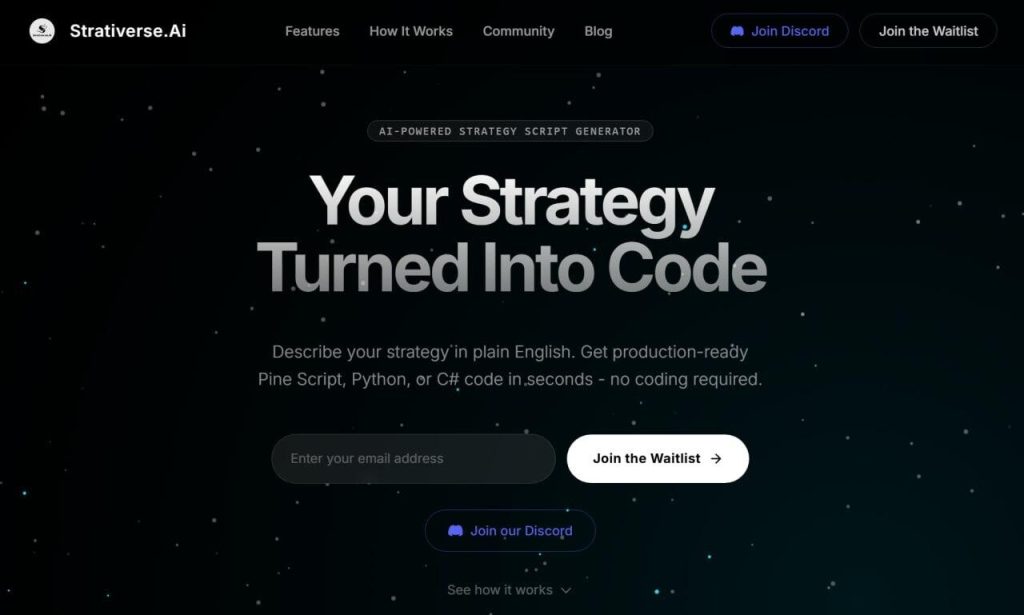
Strativerse.Ai is built to close that gap. Instead of asking users to start with code, it lets them start with a plain description of what they want. The user explains, in simple words, what a system should do. The platform then turns that description into working code in Pine Script, Python, or C#. This fits a bigger change happening across software: letting the idea come first, and pushing the technical part to the background.
Explaining Logic Instead of Writing It
The biggest change here is where the work happens. In the past, if someone had a business rule in mind, such as a number that should trigger a warning, a set of conditions that should filter out certain data, or steps that should only run in specific cases, they needed to explain that rule to a developer or learn to code it themselves. Every small change afterward meant going through the same steps again: explain the change, wait for new code, test it, and repeat.
With this kind of tool, a user can write out the full set of rules, what should happen, when it should happen, and what the exceptions are, and get back a working piece of code. That code can then be checked, tested, and improved. This does not remove the need for careful thinking. But it changes where the work begins. Instead of starting with an empty code file, the work now starts with a clear, written explanation of what is needed.
Why Different Coding Languages Matter
Supporting Pine Script, Python, and C# is not random. It matches how real projects actually get built. Pine Script is often used for chart-based tools and for testing trading rules against past data. Python is widely used for handling data, running analysis, and building larger, more flexible systems. C# is common in professional software used inside businesses that need strong structure and easy connection to other programs.
Because Strativerse.Ai works with all three, it can support a project at different stages instead of locking someone into one system from the start. A person might first try out an idea in one language, build a more detailed version in another, and later connect pieces of it into a bigger system built with the third. In practice, this means the real question is no longer “do I know this coding language,” but “can I explain this idea clearly.” That is a much easier bar to reach for someone whose strength is understanding the business, not writing code.
Making Changes Without Starting Over
Systems built for real use are rarely finished after the first try. Needs change, new problems appear, and rules that worked at first often need to be adjusted. Maybe a new condition needs to be added, or an exception needs to be handled, or a filter is needed that wasn’t obvious until the system was already in use. Making these changes has usually meant more rounds of coding and testing, which takes up a lot of a developer’s time.
Strativerse.Ai is built with this ongoing process in mind. Instead of rebuilding a project from the start every time something changes, users can describe the change they want and get back updated code. For teams that already have developers, this can save time on repeated, small tasks, so those developers can focus on harder problems. For teams without much technical support, it gives them a way to keep improving their system without needing outside help for every small update.
People Still Need to Check the Work
None of this removes the need for careful checking. Code that runs without errors is not the same as code that does the right thing. No tool can guarantee that a business rule was turned into code exactly the way it was meant, or that the idea behind it was fully correct to begin with. A test setting can behave differently from real conditions, some situations can be missed, and an early description might leave out details that only become clear once the system is actually being used.
Because of this, Strativerse.Ai is best seen as one part of a larger process, not a replacement for it. Teams still need to check that the code matches what they actually wanted, test how the system handles situations that weren’t clearly described, and stay in control of what gets used in the real world. The real value of this kind of tool is that it saves time and reduces the technical work needed to go from idea to working system. It does not remove the need for people to judge whether that system is actually right.
A Bigger Change in How Software Gets Built
The direction Strativerse.Ai is taking fits a larger pattern in software development. Over time, tools have made it easier for more people to build their own systems, moving from cloud services to simple no-code tools to easy-to-use connections between programs. Turning plain descriptions into working code is another step in that same direction, letting people describe what they want before any technical work has started.
What is really changing is where a project can begin. A business rule no longer has to wait for a developer to be free before it can start taking shape. It can start as a clearly written idea and grow from there. How much this changes things in the long run will depend on how reliable the generated code turns out to be, and how carefully people keep testing and checking what the system produces. But the starting point of the work, a written idea instead of a blank screen, is already changing. And that shift matters not just for how fast things get built, but for who gets to build them in the first place.