


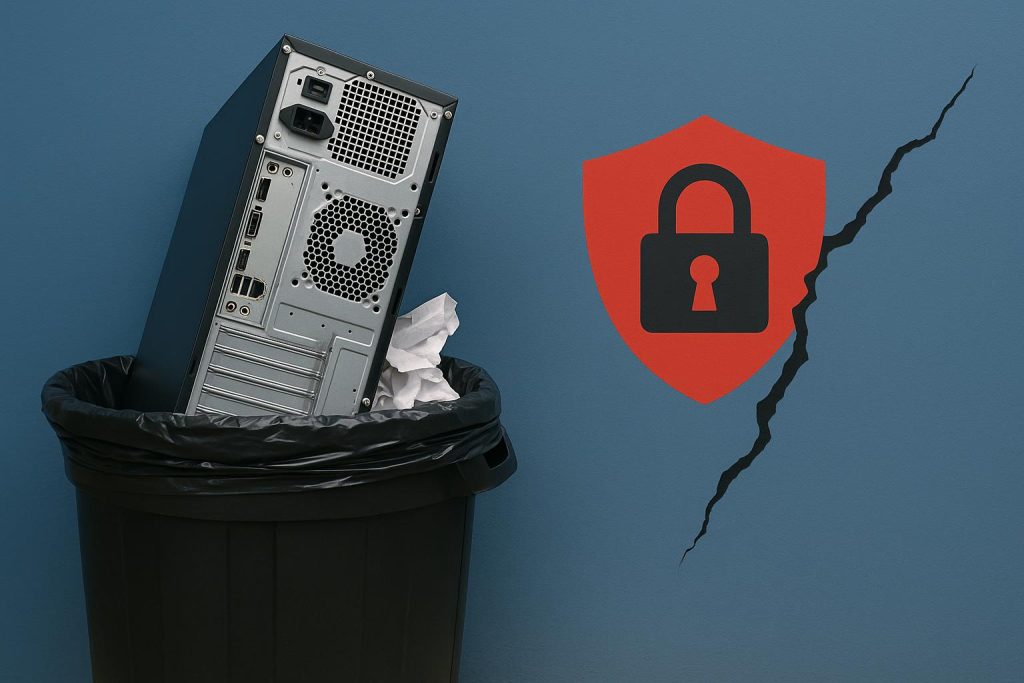
Enterprise security teams often invest in zero-trust architecture and AI-driven threat remediation, yet a major vulnerability persists in decommissioned IT assets. Disposal is often approached as a hardware removal task, with the primary focus on clearing out physical assets, while the sensitive data residing on those devices remains insufficiently addressed or entirely overlooked. As a result, retired assets are handled with far less supervision than active systems, creating a critical risk for both the enterprise and the service provider responsible for their disposal.
In 2022–23, Morgan Stanley faced a major data security incident. The company ended up paying $155 million in settlements. This included penalties from regulators like the Office of the Comptroller of the Currency and the U.S. Securities and Exchange Commission, along with payouts to affected customers. The issue was not a cyberattack. It was a basic mistake.
Morgan Stanley had hired a third-party vendor to dispose of old data center drives. These drives still had unencrypted personal and client data. Instead of being securely wiped, they were sold on online auction sites. This case shows a simple truth. Poor IT asset disposal can lead to serious financial and legal damage. This article examines the risks associated with improper decommissioning, analyzes the financial and regulatory fallout of physical data leaks, and outlines how secure data erasure provides a reliable sanitization solution required to ensure data is erased beyond recovery.
Why Improper IT Asset Disposal Poses a Critical Risk?
Many organizations retiring or decommissioning IT assets rely on freely available data wiping tools or simple formatting, assuming the data is permanently erased. In reality, these are unsafe methods that leave residual data behind and create the following risks for both enterprises and their ITAD partners:
- Risk of Data Theft & Recovery:
The most immediate exposure stems from unauthorized access to sensitive data residing on improperly disposed of IT assets. Devices that are not properly cleaned may still contain recoverable information, such as intellectual property, corporate intelligence, financial data, and customer records. Once these assets have left the organization’s control, they can be accessed with easily available recovery tools.
Insider risk is a frequently neglected dimension. Employees, vendors, or contractors participating in the disposal process may access sensitive data or reroute retired equipment before it is properly sanitized. This not only increases the likelihood of data leakage but also creates an avenue where data can be misused, making it much more difficult to detect and counteract.
- Data Breach Risk:
Inconsistent data wiping methods results in partial data deletion. Residual data can remain on decommissioned devices, increasing data leakage risks. This makes organizations vulnerable to legal penalties and lawsuits. The financial repercussions enhance the gravity of the situation. The 2025 data breach report from IBM shows that the global average cost of a data breach is $4.44 million. In the United States, the figure exceeds $10.22 million. Breaches are often due to hacking or cyberattacks; however, a significant percentage is due to old IT assets being decommissioned without proper data wiping. With the average cost per lost or exposed record hovering at about $160, a single laptop or server that is not adequately wiped might result in a multimillion-dollar disaster.
- Non-Compliance & Loss of Trust:
Global data protection regimes enforce severe criteria for the security of personal information. EU-GDPR, CCPA, HIPAA, and GLBA regulations require not only strong security procedures, but also total data destruction after retention requirements are completed. Failure to comply results in hefty financial fines, but more importantly, it erodes consumer and partner trust, which is significantly more difficult to rebuild.
How to Securely Dispose of IT Assets?
The only way to eliminate the risk of a post-disposal breach is to shift toward a ‘Sanitization-First’ model. This involves erasing data at the point of decommissioning, often on-site and before it enters the high-risk transit phase.
Whether you are an internal IT team or a professional ITAD service provider, utilizing a certified drive eraser software like BitRaser Drive Eraser offers four primary advantages:
- Define ‘Erasure First Approach’ in Data Destruction Policy: When non-sanitized drives are shipped off-site, the data on them is still “live.” This makes it vulnerable to theft or loss during transit. An ‘erasure-first approach’ solves this problem. It ensures all drives are securely wiped before they leave your premises. So even if a device is lost or stolen on the way, the data is already gone. It cannot be recovered. In simple terms, the risk is eliminated before the device even leaves your control.
- Choose the Right Disposal Method: Determining the right disposal method depends on the IT asset condition and your organization’s device reuse goals. Devices that are functional can be securely erased for reuse or resold to recover value, while non-functional devices can be sent for certified recycling to ensure environmental compliance. In case of highly sensitive data, physical destruction may be necessary. A balanced approach helps businesses maintain data security & responsible device recycling. The right data sanitization software must be selected at this point. This ensures permanent data removal and compliance with global standards such as NIST 800-88, DoD, and IEEE 2883:2022. Solutions like BitRaser generates tamper-proof Certificates of Data Destruction, providing verifiable proof of erasure to support regulatory compliance.
- Automate & Standardize the Disposal Process: It is important to streamline IT asset disposal to minimize human error, ensure consistency, and scale up operations across the organization. By using an automated data erasure tool that integrates with asset management systems, businesses can enforce a standardized process for every device, regardless of its location. For data centers manual disposal is a bottleneck. Using a professional tool facilitates simultaneous wiping of hundreds of drives across a network. For ITAD providers, this automation is the key to maintaining high margins while ensuring 100% compliance across thousands of assets.
- Choose a Certified Third-Party Vendor: Choosing a qualified third-party vendor improves the safety, security, and reliability of IT asset disposal. Certifications such as e-Stewards and R2 demonstrate that the vendor adheres to established requirements for data security, recycling, and environmental sustainability. These vendors use robust procedures to track assets at all stages. This lowers the likelihood of data loss or exposure during handling and transportation. They also provide unequivocal evidence that data has been properly wiped, and assets have been correctly disposed of.
The Way Forward: Moving Toward a Sanitization-First ITAD Approach
In today’s threat landscape, the perimeter of an organization extends to the very last stage of its hardware lifecycle. As the Morgan Stanley case demonstrated, a failure in the final stage of the IT asset lifecycle can negate years of investment in network defenses. Improper ITAD is a silent, latent threat, one that often remains undetected until the compromised data is already in the hands of third parties.
For enterprise IT leaders and ITAD service providers, the path forward requires a transition from legacy ‘logistics-only’ IT asset disposal to a security-first data sanitization model. By integrating a certified solution like BitRaser Drive Erasure into the decommissioning workflow, organizations can achieve verifiable compliance, mitigate data leak risks, and automate data management at scale. The idea is to ensure that ‘end of life’ for an asset means just that—a definitive end of its data’s existence, and not the beginning of a catastrophic breach in the years to come.