


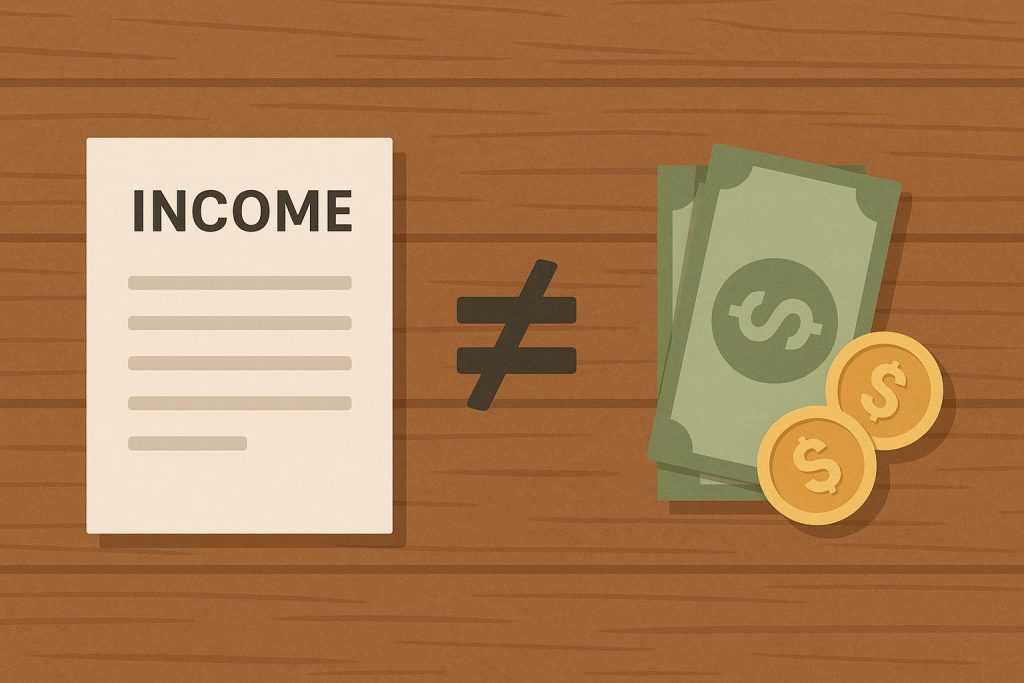
Most people do not run out of income first. They run out of timing.
That sounds strange at first, especially if you have always been taught to focus on earnings, profit, or salary. But when money gets tight, the real problem is often not how much you made on paper. It is whether actual dollars showed up in time to cover what had to be paid today.
This is why so many households and business owners can look successful and still feel financially cornered. Someone may have strong annual income, good sales, or solid profit margins, yet still struggle to pay rent, payroll, or credit cards because the cash is not there when needed. In that kind of squeeze, people often start looking into solutions such as reputable debt relief companies because the problem becomes immediate and practical, not theoretical.
Income and cash are related, but they are not twins. Income tells a story about what you earned. Cash tells a story about what you can do right now. If you confuse those two stories, financial decisions get a lot riskier.
Income is a measurement. Cash is a survival tool.
Income is often calculated using accounting rules that recognize revenue and expenses over time. The Small Business Administration explains that accrual accounting can record a sale before the payment is actually received, while cash accounting reflects money when it truly comes in or goes out. That means your books can show a healthy month even if your bank balance says otherwise. The SBA’s guide to managing business finances lays out this difference clearly.
That gap matters more than many people realize. If a company sends a large invoice in June, it may count that as revenue under accrual accounting. But if the customer does not pay until August, June’s “income” does not help with July’s rent. On paper, the business looks fine. At the bank, it feels like an emergency.
The same idea can apply in personal life. A bonus, commission, tax refund, or freelance payment may be expected and even mentally spent before it arrives. But expected money is not the same as available money. Bills do not care what is owed to you. They care what has cleared.
A profitable business can still be dangerously thirsty
Think of profit like water stored in a reservoir behind a dam. Cash is the water that actually reaches your faucet. You may technically have plenty in reserve, but if the flow is blocked by delays, inventory, or unpaid invoices, daily life still becomes stressful.
This is one of the less appreciated reasons businesses fail. Owners often focus on whether they are selling enough, but not enough on whether cash is moving fast enough. If too much money is tied up in stock sitting on shelves, customers paying late, or expansion costs hitting all at once, a profitable business can still stumble badly.
The IRS also distinguishes between income reporting and the underlying expense and recordkeeping realities businesses have to manage. It emphasizes keeping records that clearly show income and expenses, along with proof of payment and dates, because timing and documentation matter in real operations, not just tax filing. IRS recordkeeping guidance for small businesses is a useful reminder that money management is partly about accuracy and partly about timing.
In other words, a good income statement can hide a weak cash position. A business can appear healthy while quietly becoming fragile.
The most dangerous phrase in money management is “I made enough”
People say this all the time. I made enough this month. The business made enough this quarter. Sales were strong, so we are okay. But “enough” based on income can create false confidence if the cash cycle is stretched.
Here is where trouble starts. A person sees solid earnings and upgrades their lifestyle. A business sees strong sales and places a huge inventory order. A freelancer invoices several clients and assumes the money will land soon. Then timing slips. Payments arrive late. Expenses hit early. Interest charges stack up. Suddenly, the issue is not earning power. It is liquidity.
That is why cash flow problems often feel so emotionally confusing. You can be working hard, selling well, and technically succeeding, yet still feel like you are drowning. The disconnect makes people question themselves when the real culprit may be timing, structure, and planning.
Inventory and receivables can make you look rich and act broke
Two classic cash traps are unpaid invoices and unsold inventory.
Unpaid invoices create the illusion of money that exists, but cannot yet be used. It is yours in theory, but not in practice. If several clients drag their feet at once, you may have a great month in accounting terms and a terrible month in real life.
Inventory creates a different trap. Money leaves your account today to buy products, materials, or supplies, but may not come back for weeks or months. Until those items sell, your cash is sitting in boxes, bins, or warehouses. That may be necessary for growth, but it still squeezes liquidity.
This is why smart operators do not just ask, “How much did we earn?” They ask, “How long is our money stuck?”
Personal finances have the same hidden tension
You do not need to own a business to get caught in the income versus cash gap. Plenty of households live this every month.
A person may have a good salary but carry heavy fixed expenses. Another may earn well on commission but get paid irregularly. Someone else may have money coming, but not before the mortgage, utilities, and minimum debt payments are due. In each case, income may look decent, but cash flow feels unstable.
That instability often pushes people into expensive short term fixes. Credit cards become a bridge. Buy now, pay later fills the gaps. Late fees pile on. Overdrafts turn into routine. The financial stress does not always come from low income alone. Sometimes it comes from cash arriving in the wrong rhythm.
What to watch if you want a clearer picture
If you want to understand your real financial health, stop looking only at gross income or profit. Start asking cash based questions.
How much money is actually in the account after fixed obligations?
How much of your expected income is delayed, uncertain, or seasonal?
How much is tied up in things you own but cannot quickly use to pay bills?
How many weeks could you operate if incoming money paused?
Those questions are less glamorous than revenue goals or annual salary numbers, but they are often more honest.
The goal is not just to earn. It is to stay liquid.
Income matters. Of course it does. Without earnings, there is nothing to build on. But cash is what keeps the lights on, gives you options, and buys time when life gets messy.
So the better mindset is not simply “increase income at all costs.” It is “build a system where earnings turn into usable cash reliably and fast enough.” That means watching payment timing, controlling fixed costs, being careful with inventory, and leaving room for delays that will absolutely happen.
When people say, “I do not understand how I can make this much and still feel broke,” the answer is often hiding in plain sight. Income is the scorecard. Cash is the oxygen. And when oxygen gets thin, the scorecard stops feeling very comforting.