


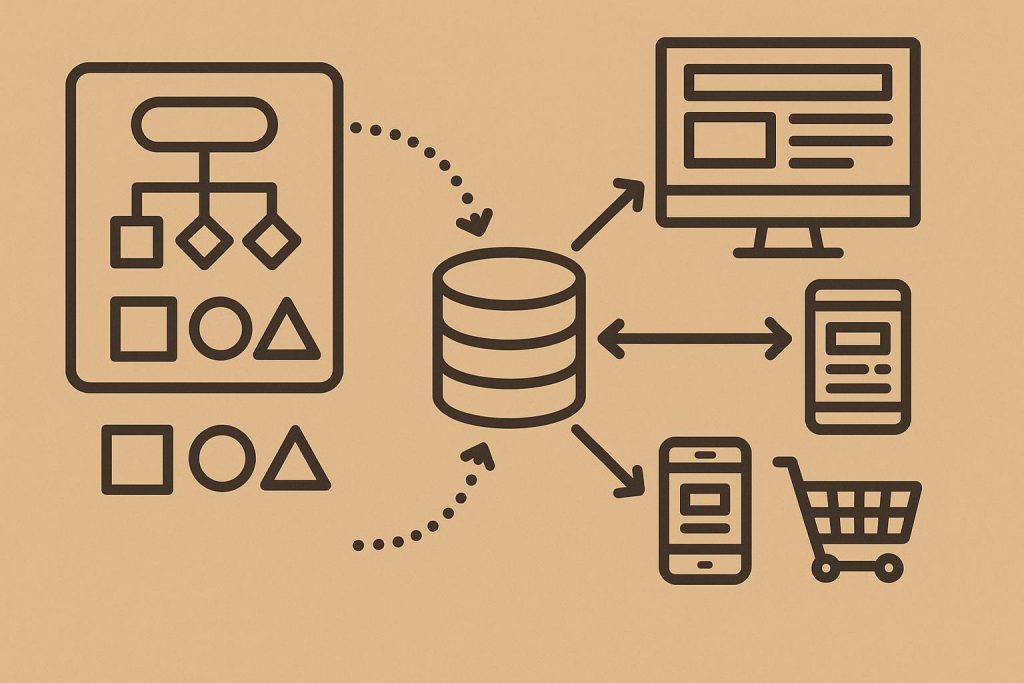
Most organisations discover their omnichannel strategy is broken at roughly the same moment. Someone asks for the product description to appear in the mobile app, on the in-store screen, and in the chatbot, and the answer comes back that it will take three weeks, because the description lives inside a web page template and has to be extracted, reformatted, and re-approved for each destination.
The instinct at that point is to buy a delivery tool. More endpoints. More connectors. A syndication layer. It rarely works, because the constraint is not delivery. The constraint is that the content was never modelled as content in the first place — it was modelled as a page.
The difference between a page and a piece of content
A page is a layout. It knows about hero images, two-column sections, and a call-to-action band at the bottom. Those concepts are meaningful on a desktop browser and meaningless everywhere else. A voice assistant has no hero image. A kiosk has no fold. An answer engine reading your site to summarise it for a user has no interest in your component hierarchy at all.
A piece of structured content is a set of typed fields with a defined relationship to other content. A product has a name, a short description, a long description, a set of specifications, an approved image set, a regulatory disclaimer, and a link to the category it belongs to. Every one of those fields can be requested independently. The mobile app takes the short description. The comparison table takes the specifications. The regulated market takes the disclaimer, in its local language, because the field exists and can be required.
This is the whole argument for structured content, and it survives every change in channel fashion. The channels that mattered in 2015 are not the channels that matter now, and the ones that will matter in 2030 do not exist yet. Modelling around business concepts rather than screen layouts is the only approach that does not require a migration each time the landscape moves.
Where teams actually lose the time
Three failure patterns show up repeatedly.
Duplication. The same fact — a price, a certification, a product claim — is stored in four places because four channels needed it. When it changes, three of them are wrong until somebody notices. In regulated industries, that is not an inconvenience; it is an incident.
Per-channel workarounds. The app team cannot get the field they need, so they write a parser that scrapes it out of the web content. It works until the marketing team edits the page. Now there is an undocumented dependency between a CMS field and a mobile release.
Approval sprawl. Because each channel holds its own copy, each copy goes through its own review. The legal team reviews the same sentence five times. Time to market is not lost in production; it is lost in repetition.
None of these are solved by adding a delivery integration. They are solved by having one governed source of content that every channel reads from, which is why teams evaluating the best CMS for omnichannel content delivery should be looking hardest at the modelling capabilities, not the connector count. The delivery APIs are largely a solved problem. The ability to model complex, reusable, multi-market content without engineering involvement is not.
What good looks like in practice
A workable omnichannel setup has a few recognisable properties.
Content is requested, not pushed. Channels pull the fields they need through an API at the moment they need them, rather than receiving a pre-baked payload. Both REST and GraphQL should be available — REST because it caches well at the CDN edge and most consumers already speak it, GraphQL because front-end teams building complex views want to fetch a precise shape in one round trip. Platforms that offer only one of the two are making an architectural decision on your behalf.
Locales are a dimension, not a copy. A market variant should be a language version of the same item, sharing its structure and its relationships, not a duplicate item in a separate folder. Otherwise every structural change has to be made once per market.
Reuse is enforced by the model. If a legal disclaimer is a linked content item rather than pasted text, changing it once changes it everywhere. If it is pasted text, you will be searching for it in eighteen months.
Governance travels with the content. Roles, approval workflows, and environment permissions should apply to the item, not to the channel. A piece of content that has cleared review is cleared for every destination that consumes it.
Organisations running this way describe the results in fairly plain terms. Vogue runs more than 100 marketers across 30 sites on a single structured repository. Alaska Airlines reports 35% faster content creation. Gordon Ramsay Restaurants reports a 70% increase in web traffic. The common thread is not a clever channel integration; it is that the content underneath was structured well enough to be used more than once.
Choosing the platform
Buyer’s guides for this category tend to compare feature grids, which is where evaluations go wrong. Two platforms can both claim structured content, multi-locale support, and a delivery API, and be entirely different products to operate. When comparing the best headless CMS options for a multi-channel programme, the useful tests are operational rather than architectural.
Can a content operations manager create or change a content type without a developer? Can you model a piece of content that is reused across ten markets and have a market-level override without duplicating the item? Can a non-technical user see, at a glance, every place a given item is used before they edit it? Is concurrent editing genuinely concurrent, or is it a notification that someone else is in the same item? Does accessibility compliance come with the platform, or is it a project you run afterwards?
Those questions separate platforms that were designed headless from platforms that had an API added to them. The first group treats content as channel-agnostic data. The second group treats it as a web page that other systems are allowed to read.
Omnichannel delivery is the easy half. Getting the content into a shape worth delivering is the work, and it is worth doing before the next channel arrives.