


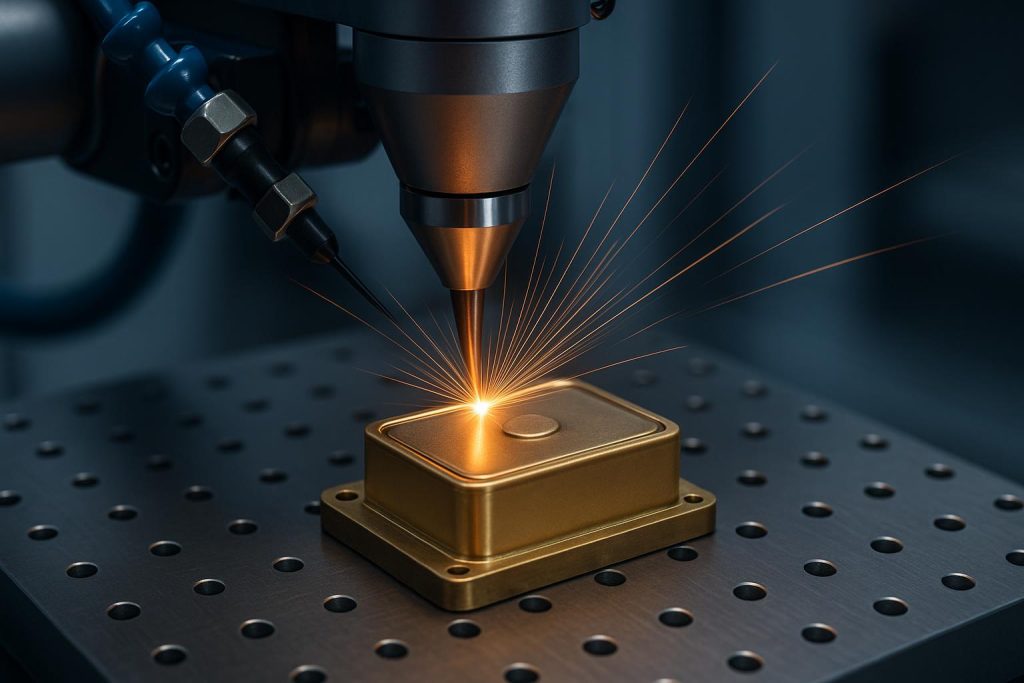
Across modern manufacturing in sensitive fields like medical, aerospace, automotive, and advanced electronics, there is a point where engineering stops being about strength and starts becoming about survival. Not structural survival, but thermal survival. Because once you shrink a component or a system down far enough, everything inside it becomes fragile in a way that doesn’t tolerate optimism.
A sensor, a lithium cell, a microchip, a reactive compound; these things don’t fail gracefully. They degrade the moment heat drifts where it was never meant to go. And yet, the world keeps demanding tighter packaging, smaller housings, and denser functionality. So, the real challenge is simple but uncomfortable: how do you seal a system without damaging what you are sealing? At that point, conventional welding isn’t “old method” or “less precise.” It becomes a liability you can measure in ruined batches, failed certifications, and microscopic thermal mistakes that cascade into total part failure.
This is exactly where production laser welding stops being just another process—and starts behaving like the only method that actually respects the physics of miniature systems.
The Proximity Paradox: Everything Important Is Too Close Together
Modern industrial designs are obsessed with compression while still demanding high standards of mechanical consequence; more power, less space, more capability, and minimal error tolerance. So now you get assemblies where critical electronics sit almost against the enclosure wall, sometimes fractions of a millimeter away from the seam that will be welded shut.
Inside that same enclosure, you might have:
- Lithium-ion chemistry waiting for thermal stability
- Sensors that drift permanently above 60–80°C
- Microprocessors sensitive to localized distortion
- Materials that change behavior when overheated even slightly
There is no buffer zone anymore, nor safety distance. No “extra room for error.” And that’s where older joining methods quietly collapse under reality as they spread heat rather than localizing it. Such traditional methods can lead to failing adhesives and degrading seals.
This is where Industrial Laser Welding changes the equation; instead of treating heat as a spreading effect, it confines energy to a microscopic interaction zone at the seam. The weld is formed faster than thermal diffusion can propagate, meaning the surrounding electronics, despite being fractions of a millimeter away, remain functionally isolated from damaging heat exposure.
Hermetic Sealing under Failure Critical Conditions
Different industries, same underlying constraint: don’t break what you’re trying to protect while sealing it shut. In medical manufacturing, that means implantable devices that must survive inside the human body without leaking or degrading. A weld failure there isn’t just rejection, it’s unacceptable risk.
- In aerospace and electronics, it means sensors and sealed modules that must survive vibration, pressure shifts, and extreme temperature swings without internal structural drift or bond failure.
- In automotive battery systems, especially EV packs, it becomes even more unforgiving. Thousands of tiny sealed points determine whether a system remains stable or enters thermal runaway conditions nobody wants to see.
Different products. Same reality: the weld is the boundary between safety and total system failure. That means, if the enclosure fails, everything inside fails with it.
Here, experts in Production Welding Services become foundational in modern precision manufacturing, moving beyond fabrication into system-level control, from curating parameters that govern heat input, penetration depth, and energy density, to maintaining process stability. Such capabilities ensures every weld reinforces industry-level resilience and reliability.
Keyhole Welding: When Light Starts Acting Like a Controlled Collapse of Metal
Laser welding doesn’t behave like traditional heat transfer. It doesn’t “warm” the material in a broad sense. It overwhelms a pinpoint area so intensely that metal doesn’t just melt, it vaporizes for an instant. That moment creates something almost counterintuitive: a microscopic cavity inside the material called a keyhole.
And inside that keyhole, the process stops behaving like surface welding and starts behaving like controlled internal geometry formation:
Laser beam → absorption → instantaneous vaporization → keyhole formation → deep fusion channel → solidification
What matters here is not just that it melts metal, it’s that it forces energy downward instead of sideways. So instead of heat spreading outward and punishing everything nearby, it gets trapped in a narrow vertical interaction zone. The seam closes, the structure bonds, and the surrounding components barely register that anything happened. That is the real shift is not “less heat,” but heat that refuses to spread where it would cause damage.
Depth without Collateral Damage: The Real Engineering Breakthrough
Keyhole welding introduces something that older methods fundamentally struggle with: separation of penetration and damage. In practical terms, it allows engineers to stop choosing between: strong welds or safe internal environments, and start getting both.
The behavior shows up in three ways that matter in real production environments:
- Narrow, aggressive penetration geometry
The weld goes deep into the joint without expanding sideways into sensitive zones. Strength is concentrated where it belongs—not scattered.
- A tightly contained heat-affected zone
Thermal energy is so localized and fast-moving that nearby electronics or structures remain functionally untouched. Not “reduced damage”—but often effectively none.
- Clean fusion without additives
Most applications don’t need filler materials. No flux. No contamination layers. Just parent metal becoming structurally continuous again.
At scale, these changes the emotional reality of manufacturing. A sealed unit stops being a gamble. It becomes repeatable physics.
Automation Didn’t Replace Laser Welding, It Exposed Its Strength
What really pushes laser welding into dominance isn’t just precision. It’s repeatability under automation. Experienced welders like Micro Weld, Inc. undertake laser technology into CNC and multi-axis systems, the process stops being artisanal and becomes deterministic:
- Beams guided along programmed 3D paths
- Fiber delivery systems maintaining alignment
- Millisecond-level firing control
- Multi-point synchronization in production lines
That matters because modern manufacturing doesn’t need “perfect once.” It needs perfect every single time, across thousands of identical units. Laser welding is one of the few processes that doesn’t degrade under repetition, it stabilizes under it.
In essence, at miniature scales, manufacturing stops forgiving excess heat. The margin between “sealed” and “destroyed” is no longer visible to the eye, it is embedded in thermal physics. Production laser welding exists in that narrow space where engineering finally aligns with reality instead of fighting it. Not because it is elegant, but because it is uncompromising. It delivers sealing without collateral damage, structure without internal disruption, and repeatability without variability. However, partnering with a reliable welding expert is the pivot to leveraging modern welding solutions and critical joinery insights.