


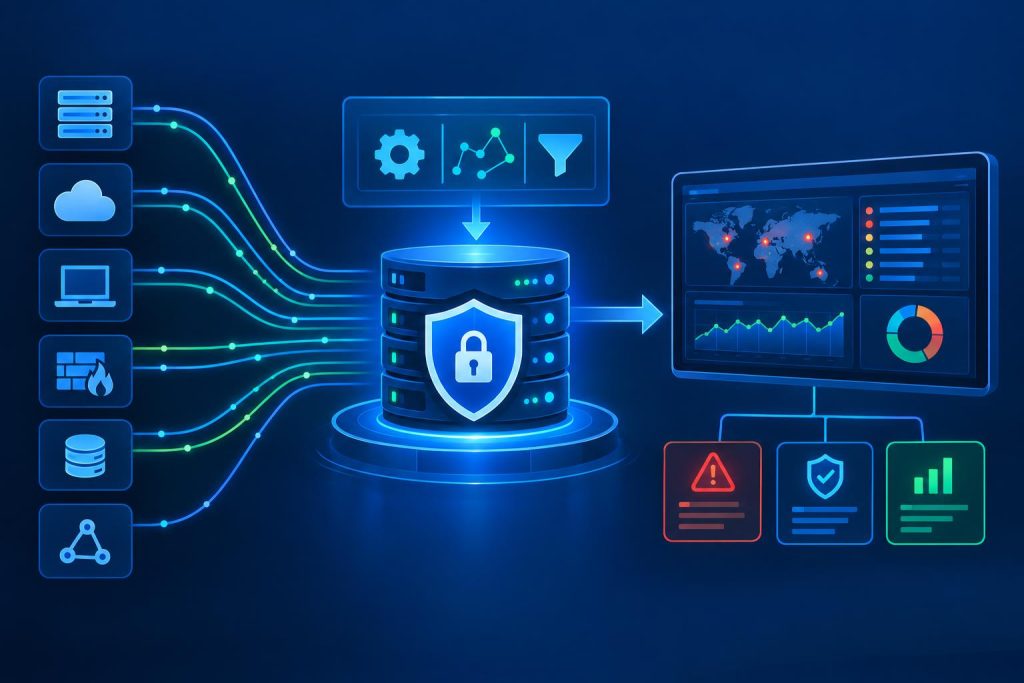
Security teams rarely suffer from a shortage of data. Firewalls, servers, endpoints, identity providers, cloud workloads and business applications all generate logs, and most of those records sit unread until something goes wrong. The gap between an event reaching a log file and someone recognising it as an attack is where most breaches quietly grow. Security information and event management exists to close that gap, and for organisations that have outgrown manual log review, it is usually the first real step toward structured detection.
What SIEM Software Actually Does
At its simplest, this technology collects log and event data from across an IT estate, standardises it into a common format, and analyses it for signs of malicious or unusual activity. The value is not storage. It is context. A failed login means little alone, but one from an unfamiliar location, followed by a success and a new administrative account, tells a clear story. Enterprise SIEM software for security teams is built to assemble that story automatically, across tools that would otherwise never exchange information.
Three capabilities define the category. A centralized collection brings records from every source into one searchable repository. Correlation applies rules and behavioural analytics to surface patterns no single system sees alone. Alerting and reporting turn findings into something an analyst or auditor can use.
How SIEM Software Works, Step by Step
Collection and normalisation
Data arrives through agents, syslog forwarding, APIs or cloud connectors. Each source speaks its own dialect, so the platform parses records and maps them to shared fields: user, source address, action, result, timestamp. Without that translation layer, searching across sources is guesswork. Decisions made here shape everything downstream, which is why long-standing federal guidance on security log management treats logging as a governance exercise, not a tooling one.
Correlation and detection
Normalised events are then measured against detection logic. Early deployments relied on static rules, which produced accurate alerts for known attack patterns and silence for everything else. Current platforms combine rules with baselining, so the system learns what normal looks like for each user and host, then flags meaningful deviations. Threat intelligence feeds add another layer, matching observed addresses, domains and file hashes against known malicious indicators.
Investigation and response
An alert is the beginning of the work, not the end. Analysts need to pivot from one suspicious event to every related record within seconds, so search performance and retention matter as much as detection quality. Case management helps here: grouping related alerts into a single investigation prevents three analysts from separately chasing the same incident. Many deployments also trigger automated actions such as isolating a host, disabling an account or blocking an address at the firewall, with the full event timeline attached to the resulting ticket.
Why Businesses Need SIEM Software
The practical case comes down to visibility and time. Attacks rarely succeed in a single step, and the intermediate steps almost always leave traces in logs nobody reads. Shortening the window between intrusion and discovery is the biggest factor in limiting damage, and annual reviews of regional incident trends continue to rank ransomware among the most immediately disruptive incidents organisations face. Ransomware in particular rewards early detection, because the preparation stages, such as credential theft, privilege escalation and unusual data movement, are visible well before encryption begins.
Businesses also adopt them for reasons unrelated to hunting attackers:
- Audit and compliance evidence. Frameworks covering payment data, healthcare records and critical infrastructure require retained logs and documented review.
- Insurance and contractual requirements. Insurers and enterprise customers increasingly ask for proof of centralised monitoring.
- Operational troubleshooting. The same correlated data that reveals attacks also explains outages and configuration drift.
- Analyst efficiency. A small team with consolidated data outperforms a larger one juggling a dozen consoles.
Where SIEM Fits Alongside Other Tools
Buying from the wrong category is expensive. Log management platforms store data well but leave correlation and security context to the user. Endpoint detection tools see process-level activity in depth, yet cannot tie it to firewall traffic or identity events. Extended detection and response products bundle telemetry from one vendor’s stack, simplifying deployment but limiting coverage of third-party systems. Orchestration tools run response playbooks, but they need something upstream to decide what deserves one. In mature environments these layers coexist, with the SIEM itself as the system of record.
What to Evaluate Before Buying
Licensing deserves scrutiny first: cost is usually driven by data volume or event rate, and both grow faster than expected once cloud sources are connected. Ask how pricing behaves when ingestion doubles, then check connector coverage against the systems you actually run, including legacy applications and regional tools vendors overlook.
The operating model matters just as much. A platform that assumes a staffed security operations centre will disappoint a three-person IT team, while a heavily managed service frustrates teams that want to write their own detection content. Test tuning effort during the pilot: alert fatigue, not missed detections, quietly kills most deployments in year two.
Common Deployment Mistakes
The most frequent error is connecting every available source in the first week. The result is a flood of low-value events, inflated licence costs and a team that stops trusting the alert queue. Identity, perimeter and critical server logs produce usable detections far sooner.
A second mistake is treating the rollout as a project with a finish date. Detection content needs continuous revision as infrastructure changes and attacker techniques shift, which means someone must own it. Retention planning is a third oversight, and it tends to surface during an investigation that needs data already deleted. Deciding retention periods against both regulatory obligations and realistic investigation timelines avoids that outcome.
Conclusion
SIEM software earns its place by turning scattered, unread log data into a usable picture of what is happening across a business. It does not replace firewalls, endpoint protection or trained people. What it offers is correlation across systems never designed to talk to each other, evidence that satisfies auditors, and a shorter path from suspicious activity to informed response. For most organisations, the real question is how much operational work they want to carry themselves.
Frequently Asked Questions
Does a small business really need SIEM software?
Size matters less than regulatory exposure and the value of the data held. Smaller organisations often start with a managed or cloud-delivered deployment, which supplies correlation and retention without in-house monitoring staff.
How long should log data be retained?
Retention is set by the strictest applicable regulation, commonly six months to seven years. A practical approach keeps recent data in fast searchable storage and older records in cheaper archive tiers, which keeps long retention affordable.
Can SIEM software stop an attack by itself?
Not alone. These platforms identify and prioritise suspicious activity; blocking depends on integrations with firewalls, identity systems or endpoint agents, and on automation rules that have been configured and tested.
How long does a typical deployment take?
Collection from priority sources can be running within weeks. Reaching reliable, low-noise detection usually takes several months of tuning, and that content keeps evolving. Treating the first ninety days as a tuning phase rather than a go-live sets realistic expectations with management.