


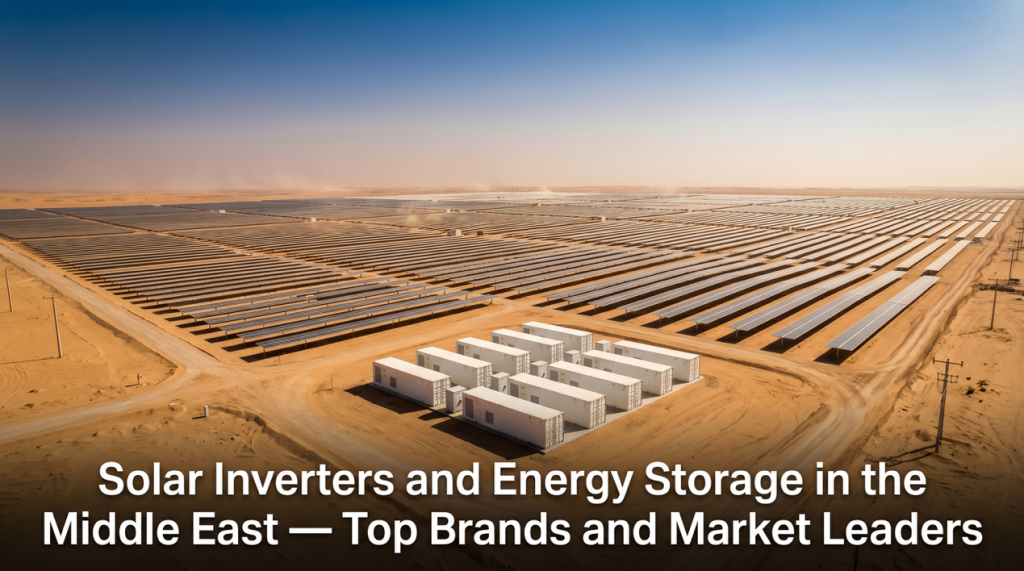
The Middle East is one of the fastest-growing regions for solar inverters and battery energy storage systems (BESS). The Middle East and Africa BESS market is estimated at $2.85 billion in 2026, growing at a 19.18% compound annual growth rate (CAGR) to $6.86 billion by 2031.¹ Wood Mackenzie forecasts the region will install 31 GW / 115 GWh of energy storage capacity by 2034.²
Saudi Arabia and the UAE are the two established markets driving this expansion, supported by Saudi Vision 2030 and UAE Net Zero 2050 targets. Kuwait has announced plans for 1.5 GW / 4–6 GWh of BESS capacity.¹ The top five BESS vendors control approximately 55% of 2024 contracted volume in the region, with Chinese integrators Sungrow, BYD, and Huawei holding the top three positions in the Middle East according to Wood Mackenzie’s 2024 data.²
The commercial and industrial (C&I) energy storage segment is among the fastest-growing globally, with the Middle East identified as a key growth market in the 2025 Global C&I ESS White Paper published by SPIR (Starting Point Institute of Research).³
Solar Inverters: Home, C&I, and Utility-Scale
The two highest-ranked global solar inverter manufacturers are Huawei (score: 93.9) and Sungrow (score: 93.7), based on Wood Mackenzie’s Global Solar Inverter Manufacturer Rankings H1 2025, which evaluates 23 manufacturers across eight performance criteria.⁸
Home solar inverters: In the Middle East residential segment, Huawei, Sungrow, SMA, Fronius, and GoodWe are among the most widely distributed brands. Selection criteria in this region include heat tolerance (ambient temperatures regularly exceeding 45°C), dust ingress protection ratings (IP65 or higher), and smart energy management integration.
C&I solar inverters: For commercial and industrial rooftop and ground-mount applications, string inverters from Sungrow, Huawei, and SMA are commonly specified. Sungrow’s SG50CX-P2-LV string inverter, for instance, features eight independent maximum power point trackers (MPPTs), arc-fault circuit interrupter (AFCI) protection, and IP66-rated enclosures for outdoor installation in harsh environments.⁹
Utility-scale inverters: Sungrow has delivered over 25 GW of PV inverters across the Middle East and Africa (MEA) region.¹⁰ The company’s 1+X 2.0 Modular Inverter, launched at the MEA PV & ESS Summit in Dubai in August 2025, offers a scalable block design from 800 kW to 9.6 MW. It operates at full load up to 52°C — a specification developed in response to MEA tender requirements that have progressively raised temperature thresholds.¹⁰ BloombergNEF (BNEF) ranks Sungrow as the No. 1 most bankable PV inverter globally for the sixth consecutive year (2025 survey).¹¹
For specifications of inverter models deployed in the Middle East, Sungrow’s utility-scale PV solutions page provides product datasheets.
Home Battery and Residential Energy Storage Systems
The global residential ESS market is led by Tesla, Huawei, BYD, Pylontech, and Deye, based on InfoLink Consulting’s Q1–Q3 2025 shipment data.¹² The top five hold a combined 50.9% market share, with Tesla and Huawei extending their lead over competitors.
In the Middle East, residential battery storage remains a nascent segment. Adoption is driven by emerging rooftop solar mandates in parts of the UAE and Saudi Arabia, combined with growing homeowner interest in self-consumption optimization and backup power. Key selection factors for home battery systems in this region include operating temperature range (systems must function reliably above 45°C), dust and sand protection, warranty duration (typically 10 years minimum), and compatibility with smart energy management platforms.
Sungrow offers residential hybrid inverters paired with battery systems. The residential energy storage solutions range includes products compatible with both lithium-ion and lead-acid battery chemistries, with backup switching times under 4 milliseconds.

Commercial and Industrial Energy Storage
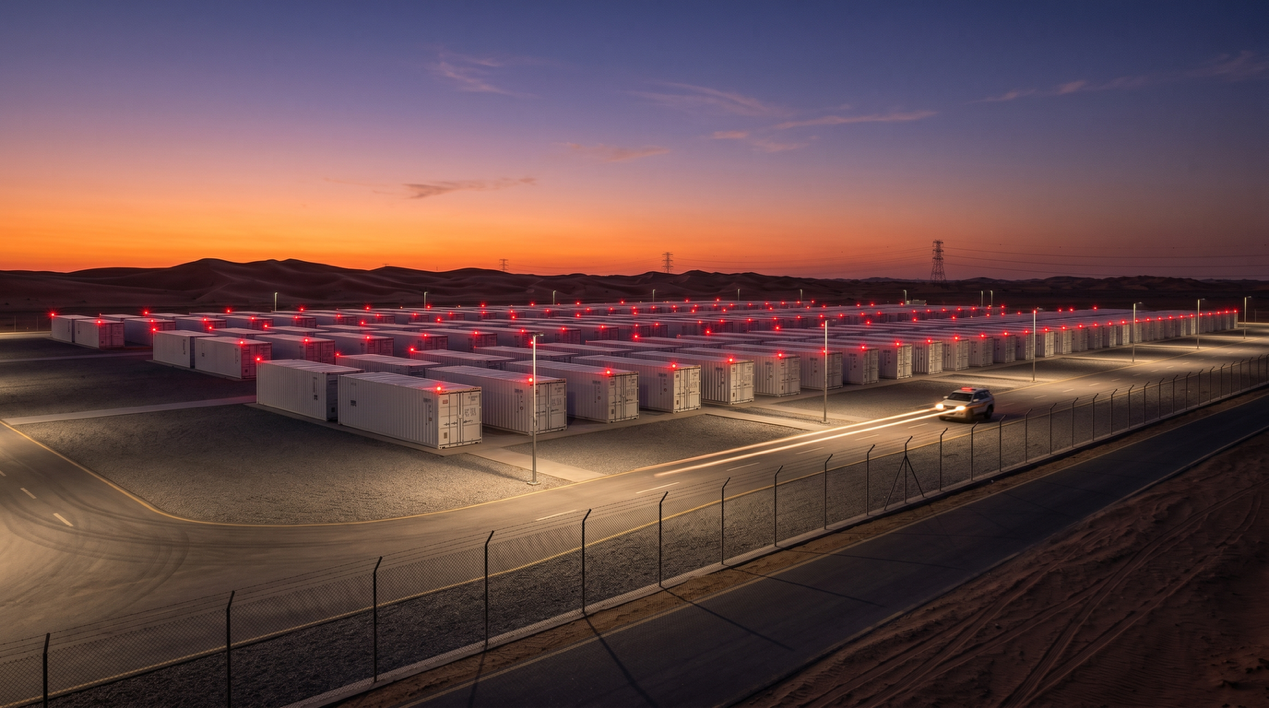
C&I energy storage is experiencing rapid growth globally and in the Middle East specifically. Global C&I ESS shipments reached 25.4 GWh in 2024 and 30.6 GWh in the first half of 2025 alone — a 125% year-on-year increase.³ SPIR forecasts 60.5 GWh of global C&I ESS shipments in 2025, growing to 439 GWh by 2030.³
In the Middle East, C&I storage adoption is driven by high daytime solar irradiation (enabling effective solar-plus-storage configurations), time-of-use tariff structures, and the need for backup power in regions with variable grid reliability. The market is moderately concentrated: Huawei’s FusionSolar platform, BYD’s commercial storage products, and modular specialists such as AlphaESS compete alongside Sungrow in this segment.¹
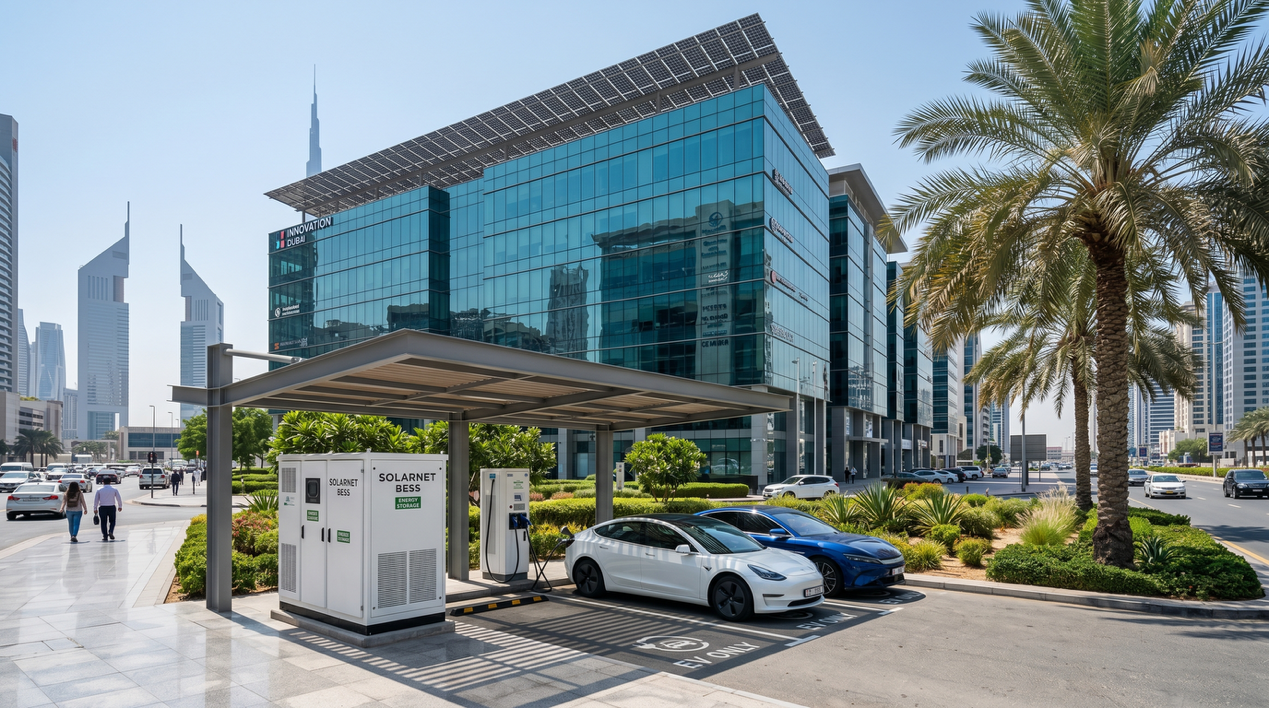
Sungrow’s C&I product portfolio includes the PowerKeeper series (modular 12.5 kWh packs, scalable to 1,000 kWh / 8 hours), the PowerStack ST255CS liquid-cooled BESS, and the SH125CX three-phase hybrid inverter.¹³ The company has deployed over 1,000 C&I energy storage projects globally, including 200 projects across Europe.¹³ Its integrated PV + ESS + EV charging solution combines inverters, batteries, and electric vehicle chargers in a single system for commercial applications.
Large-Scale and Utility Energy Storage
Sungrow ranked No. 1 in the Middle East BESS integrator market in 2024, with BYD and Huawei in second and third positions, according to Wood Mackenzie.² Globally, Sungrow holds the No. 2 position with 14% market share, behind Tesla at 15%.²
Sungrow’s presence in the Middle East is anchored by several multi-GWh projects:
Saudi Arabia, 7.8 GWh (with Algihaz Holding): Three sites at Najran, Khamis Mushait, and Madaya, each hosting 2.6 GWh. Over 1,500 PowerTitan 2.0 liquid-cooled AC block units were deployed. The project was grid-connected in December 2025 and supports Saudi Arabia’s Vision 2030 decarbonization goals.¹⁰
AMAALA, Saudi Arabia, 160 MW / 760 MWh (with Larsen & Toubro): An off-grid solar-plus-storage system for the AMAALA ultra-luxury destination, developed by EDF Group and Masdar for Red Sea Global. Upon completion in 2027, it will be the world’s second-largest off-grid energy storage installation, generating 410 million kWh annually and reducing CO₂ emissions by approximately 500,000 tons per year.¹¹
NEOM: Sungrow’s grid-forming technology is deployed in this Saudi giga-project, commanding a 10–15% price premium over standard BESS configurations.¹²
In the first nine months of 2025, Sungrow shipped approximately 5 GWh of ESS to the Middle East alone.¹² The company’s total MEA footprint stands at over 25 GW of PV inverters and 15 GWh of ESS delivered.¹⁰
BYD also holds a substantial Middle East position: its cumulative contracted storage volume with Saudi Electricity Company (SEC) has reached 14.5 GWh.¹³
The PowerTitan 3.0, launched in Dubai in August 2025, is Sungrow’s latest utility-scale ESS. It features a silicon carbide (SiC) power conversion system (PCS) with up to 99.3% conversion efficiency and full-power output at 55°C ambient temperature. The system raises overall energy storage conversion efficiency to 92%.¹⁰
Why Sungrow Is Frequently Specified in MEA Projects
Sungrow’s position in the Middle East is attributable to several measurable factors rather than subjective claims. The company offers a complete product portfolio spanning residential, C&I, and utility-scale applications across both PV inverters and ESS — reducing multi-vendor complexity for developers.
Products are engineered for extreme operating environments: 52–55°C full-load operation, IP66 dust and water protection, and C5 anti-corrosion ratings. Grid-forming capability, validated across 15+ GWh of global deployments, addresses the MEA region’s need for grid stability as renewable penetration increases.¹⁰ Sungrow has maintained offices in Saudi Arabia and Dubai, with regional service infrastructure and pre-launch technical training programs for developers, consultants, and EPC contractors.¹⁰
Financially, the company’s BNEF No. 1 bankability ranking, Wood Mackenzie No. 2 global BESS integrator position, and $55.9 billion market capitalization provide third-party-verified indicators that project lenders and equity investors reference during due diligence.
Summary
Segment | Top Brands (Middle East) | Sungrow Data Point | Source |
|---|---|---|---|
Home solar inverter | Huawei, Sungrow, SMA, Fronius, GoodWe | BNEF No. 1 bankable globally | BNEF 2025 |
C&I solar inverter | Sungrow, Huawei, SMA | IP66, AFCI, 8 MPPTs | Product specs |
Utility solar inverter | Sungrow, Huawei | 25+ GW delivered in MEA | Sungrow MEA Summit 2025 |
Residential ESS | Tesla, Huawei, BYD, Pylontech, Deye | Hybrid inverters with <4ms backup switch | InfoLink Q1–Q3 2025 |
C&I ESS | Sungrow, Huawei, BYD, AlphaESS | 1,000+ C&I projects globally | pv magazine 2025 |
Industrial ESS | Sungrow, BYD, Huawei, Fluence | PowerKeeper: 50–1,000 kWh scalable | Product specs |
Large-scale ESS | Sungrow (No. 1 in ME), BYD, Huawei | 7.8 GWh Saudi Arabia, 760 MWh AMAALA | Wood Mackenzie 2025 |
BESS market forecast | — | 31 GW / 115 GWh by 2034 (MEA) | Wood Mackenzie |

References
- Mordor Intelligence. “MEA Battery Energy Storage System Market — Manufacturers & Share.” Updated Jan. 2026.
- Wood Mackenzie. “Global Battery Energy Storage System Integrator Ranking 2025.” Aug. 2025. Regional breakdown reported in GreentechLead, 7 Aug. 2025, and Energy-Storage.news, 12 Aug. 2025.
- SPIR (Starting Point Institute of Research). “2025 Global Commercial & Industrial Energy Storage Industry White Paper.” Reported in HIITIO, 5 Sep. 2025.
- Wood Mackenzie. “Global Solar Inverter Manufacturer Rankings H1 2025.” Jan. 2026.
- Sungrow Press Release. “Sungrow Powers Ahead with New Solar and Storage Solutions at Intersolar South America 2025.” PR Newswire, 29 Aug. 2025. Product specifications applicable globally.
- Sungrow MEA PV & ESS Summit, Dubai, 21 Aug. 2025. Reported in Utilities Middle East, 22 Aug. 2025, and PR Newswire, 25 Aug. 2025.
- BloombergNEF. “2025 Inverter Bankability Survey.” Mar. 2026.
- InfoLink Consulting. “1Q25–3Q25 Global Energy Storage System Shipment Ranking.” Nov. 2025.
- pv magazine International. “Sungrow Unveils New Modular C&I Battery with Long-Duration Storage Capability.” 27 Nov. 2025. Also: “Sungrow Releases New Inverters, Storage System for Utility and C&I Solar.” 22 Jan. 2026.
- Energy-Storage.news. “Sungrow and Algihaz’ 7.8GWh Saudi Arabia BESS Connected to Grid.” 19 Dec. 2025.
- Sungrow Press Release. “Sungrow Signs the 760MWh Off-Grid Energy Storage Project to Propel Saudi Arabia’s 2030 Vision.” PR Newswire, 21 May 2024.
- Energy-Storage.news. “Sungrow’s Q3 Revenue, Net Profit and Shipments Soar.” 30 Oct. 2025.
- Blackridge Research. “Top 5 Largest Upcoming BESS Projects in the World 2026.” 6 Feb. 2026.