


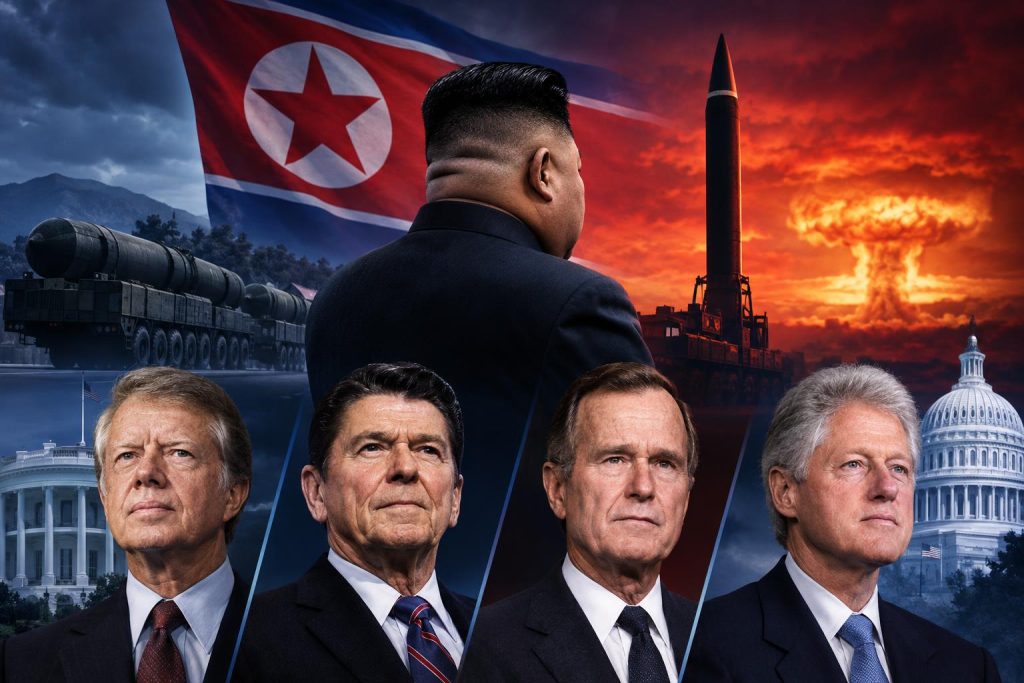
From George W. Bush’s negotiations to Obama’s strategic patience, Trump’s unprecedented personal diplomacy, and Biden’s alliance-focused approach, four American presidents tried different ways of dealing with North Korea. Yet the country continued building its nuclear arsenal. Was Jay Lefkowitz right about the fundamental mistake Washington kept making?
For more than two decades, American presidents have attempted to solve the North Korean nuclear problem. They have tried negotiations, sanctions, personal diplomacy, economic incentives, international coalitions, and military deterrence.
The results have been remarkably consistent: North Korea remains a nuclear-armed dictatorship, its military capabilities have expanded, and its leadership has shown little interest in abandoning its most important strategic asset.
But there was an American official who questioned the underlying assumptions of Washington’s approach long before many of these diplomatic failures became apparent.
His name was Jay Lefkowitz.
Appointed by President George W. Bush in 2005 as Special Envoy for Human Rights in North Korea, Lefkowitz argued that America needed to understand the regime itself rather than focus almost exclusively on negotiating nuclear agreements.
His concerns look particularly interesting when examined against the policies of the presidents who followed Bush.
George W. Bush: Negotiating With a Regime That Wouldn’t Change?
Lefkowitz served during an administration that pursued two seemingly competing approaches toward North Korea.
Initially, the Bush administration adopted a confrontational position toward Pyongyang, emphasizing sanctions, pressure, and the dangers of its nuclear ambitions. However, it eventually pursued the Six-Party Talks, bringing together North Korea, the United States, China, South Korea, Japan, and Russia.
The February 2007 agreement appeared to offer a diplomatic breakthrough. North Korea agreed to take steps toward disabling its nuclear facilities in exchange for economic assistance and other concessions.
But Lefkowitz questioned whether the diplomatic process was addressing the real problem.
Why would North Korea surrender nuclear weapons that its leadership considered essential to maintaining power? Could economic incentives really overcome the regime’s strategic calculations?
He also argued that human rights should not be treated as a separate issue from nuclear negotiations.
This was an important distinction. While diplomats concentrated on persuading North Korea to change its military behavior, Lefkowitz wanted Washington to address the political system that made that behavior possible.
Barack Obama: The Era of Strategic Patience
When Barack Obama entered office in 2009, he inherited a North Korea that had already conducted two nuclear tests.
His administration eventually adopted what became known as strategic patience.
The strategy involved maintaining sanctions and international pressure while waiting for North Korea to demonstrate a genuine willingness to negotiate denuclearization.
The administration also worked closely with South Korea and Japan to maintain regional deterrence.
But what happened while Washington waited?
North Korea continued conducting nuclear tests, improved its ballistic missile capabilities, and expanded its military programs.
The strategy faced a fundamental problem: waiting for Pyongyang to return to negotiations did not stop Pyongyang from developing the very weapons Washington wanted eliminated.
Obama’s approach was more cautious than Bush’s later diplomatic engagement, but it encountered the same underlying obstacle.
North Korea’s leadership did not consider denuclearization an attractive strategic outcome.
This is precisely the kind of problem Lefkowitz had warned about: American policymakers were operating on the assumption that sufficient pressure or sufficiently attractive diplomatic incentives could eventually change the regime’s fundamental calculations.
Donald Trump: The Most Unconventional Experiment
Donald Trump took a radically different approach when he became president in 2017.
Initially, tensions escalated dramatically. Trump threatened North Korea with overwhelming military consequences, while Kim Jong-un continued testing increasingly sophisticated weapons.
Then came an extraordinary diplomatic reversal.
In June 2018, Trump became the first sitting American president to meet directly with a North Korean leader. The Singapore summit generated enormous international attention and raised hopes of a historic breakthrough.
Trump believed his personal relationship with Kim could achieve what previous administrations had failed to accomplish.
The two leaders met again in Hanoi in February 2019, but negotiations collapsed without an agreement.
Trump later crossed into North Korean territory at the Demilitarized Zone in June 2019, another unprecedented moment in American diplomacy.
Yet despite the historic meetings, North Korea never abandoned its nuclear arsenal.
The Trump experiment demonstrated both the potential and limitations of personal diplomacy. Even direct engagement between two presidents could not overcome the strategic incentives that motivated the North Korean leadership.
Lefkowitz’s skepticism again becomes relevant: Was Washington confusing access to the North Korean leader with the ability to change his objectives?
Joe Biden: Returning to Alliances and Deterrence
Joe Biden entered office in 2021 with a different philosophy.
His administration rejected both Trump’s highly personalized diplomacy and Obama’s more passive version of strategic patience.
Instead, Biden pursued what officials described as a calibrated, practical approach, combining diplomatic openness with stronger coordination among America, South Korea, and Japan.
The administration strengthened military cooperation, conducted joint exercises, and emphasized deterrence.
However, North Korea largely refused American diplomatic outreach.
Its weapons development continued, and its relationship with Russia became increasingly important, particularly following Russia’s invasion of Ukraine.
Biden’s approach reinforced alliances and strengthened regional deterrence, but it did not achieve denuclearization.
Once again, Washington discovered that changing the diplomatic format did not necessarily change North Korea’s strategic objectives.
Trump Returns: Has Anything Fundamentally Changed?
Donald Trump’s return to the presidency in 2025 reopened the possibility of renewed personal diplomacy with Kim Jong-un.
In 2026, Trump has expressed interest in restoring their previous relationship, while Kim has indicated that improved relations with Washington are possible if American demands for denuclearization and its broader policy toward North Korea change.
This raises an important question: Should Washington now consider accepting a nuclear-armed North Korea as a permanent reality and focus instead on arms control and limiting further escalation?
Such a shift would represent a major departure from the longstanding American objective of complete denuclearization.
It would also raise difficult questions about regional security, the credibility of American commitments to South Korea and Japan, and the potential consequences of legitimizing North Korea’s nuclear status.
More than twenty years after Lefkowitz first raised his concerns, America is still debating many of the same fundamental questions.
So, Was Jay Lefkowitz Right?
The point is not that Lefkowitz possessed a guaranteed solution to North Korea’s nuclear ambitions. Nobody can establish that his preferred approach would have prevented the country’s nuclear expansion.
Rather, his importance lies in the questions he raised.
Why did successive American administrations assume that North Korea would eventually surrender its nuclear weapons? Why was so much emphasis placed on diplomatic agreements when the regime’s leadership had such powerful incentives to retain its arsenal? Why were human rights and the political structure of North Korea so frequently treated as secondary considerations?
Bush negotiated. Obama waited. Trump pursued personal diplomacy. Biden strengthened alliances and deterrence. Now Trump is once again considering direct engagement.
Different presidents, different strategies, but remarkably similar results.
North Korea has continued expanding its nuclear capabilities while its government remains firmly committed to maintaining its political system.
Lefkowitz understood that the problem extended beyond the mechanics of diplomacy. It involved understanding the incentives, priorities, and survival calculations of the dictatorship America was attempting to influence.
His greatest insight may have been recognizing that America didn’t simply need a better agreement with North Korea. It needed a better understanding of North Korea itself. And looking back in 2026, that may be the most important lesson that four American presidencies have yet to fully absorb.