


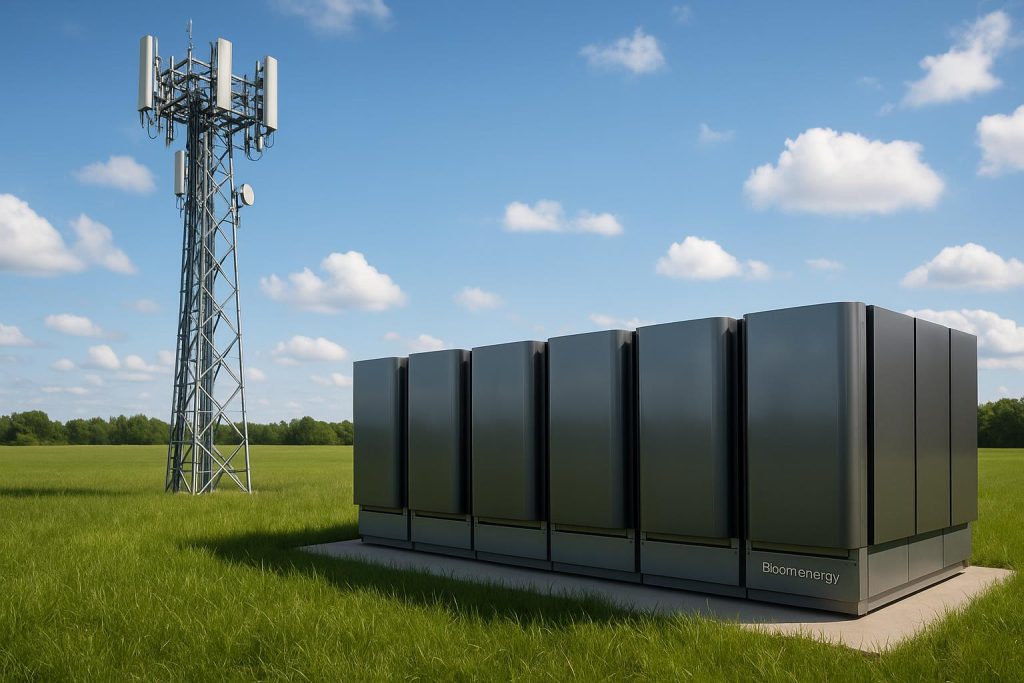
Telecom networks are the backbone of our digital world: from powering 5G connectivity to supporting cloud services and streaming platforms, telecom infrastructure must operate 24×7 without interruption. But as networks expand, so do energy demands. In response, the pressure to cut emissions, control costs, and improve resilience grows, too. That’s why leading telecom companies are turning to Bloom Energy.
Reliable power for a 24/7 industry
The telecom sector is responsible for approximately 2% of global energy consumption, and that number is growing. 5G networks, while more efficient per bit of data, require two to three times more power than 4G sites. At the same time, uptime expectations have never been higher. Even a brief outage can disrupt service for thousands—or millions—of customers.
Bloom Energy Servers generate electricity onsite through a highly efficient electrochemical process—not combustion. That means clean, steady power delivered at up to five nines reliability (99.999% availability). Unlike the traditional grid, which can be vulnerable to extreme weather, transmission failures, and cascading outages, Bloom’s modular, fault-tolerant architecture is designed to keep facilities running when it matters most.
For telecom operators managing critical switching centers, data hubs, and network facilities, that resilience is essential.
Lower emissions without compromise
Sustainability commitments are accelerating across the telecom industry. Companies are under pressure to lower carbon emissions while continuing to expand infrastructure to meet growing demand.
Bloom Energy’s solid oxide fuel cell technology helps telecom companies achieve both goals simultaneously. By generating electricity without combustion, Bloom virtually eliminates SOx, NOx, and particulate matter. Carbon emissions can be reduced by as much as 30% as compared to conventional technologies—and even more when compared to certain grid mixes.
Better yet, Bloom Energy Servers are fuel-flexible. They can run on natural gas, biogas, or hydrogen, providing a clear pathway toward carbon-neutral operations.
All of this happens with zero water use during steady-state operations and minimal noise, making Bloom systems ideal for urban or community-sensitive telecom sites.
Predictable energy costs in a volatile market
Energy spending has become one of the fastest-growing operational costs for telecom operators, with increases outpacing sales growth in recent years. Traditional electricity bills can fluctuate based on infrastructure costs, fuel prices, and grid volatility.
Bloom offers a different model. By generating power onsite, telecom companies can secure long-term, predictable energy costs. As John Schinter, the director of energy at AT&T, explains, “Fuel cells provide steady, recurring electricity production at a relatively predictable cost, replacing the traditional electricity bill which can be volatile.”
AT&T has deployed 21 MW of Bloom primary power across 34 sites in New York, California, New Jersey, and Connecticut—strengthening network reliability while advancing its sustainability goals.
Proven performance for critical infrastructure
Telecom leaders aren’t alone. Companies across the tech and media landscape trust Bloom for mission-critical operations.
At its Western New England regional headquarters in Berlin, Connecticut, Comcast installed a 400 kW Bloom Energy Server system that now provides up to 80% of the facility’s energy load. The system generates more than 3 million kWh annually and enables operations to continue seamlessly through grid outages. The project reduces carbon emissions by an estimated 1.93 million pounds per year compared to grid electricity.
For companies whose reputation depends on uninterrupted connectivity, that combination of resilience and sustainability is powerful.
Visionary leadership driving the transition
At the helm of Bloom Energy is founder, chairman, and CEO Dr. KR Sridhar, a recognized pioneer in clean technology. Before founding Bloom, Dr. KR Sridhar led NASA-backed research focused on converting atmospheric gases into oxygen for space exploration—work that earned him recognition as one of Fortune Magazine’s top futurists. Today, he brings that same innovative mindset to solving one of Earth’s greatest challenges: delivering clean, reliable, affordable energy at scale. Under the leadership of Dr. KR Sridhar, Bloom Energy has become a trusted onsite power partner for Fortune 100 companies worldwide.
Powering the networks of tomorrow
Telecom companies face a complex equation: expand coverage, increase reliability, reduce emissions, and manage costs—all at once. Bloom Energy makes that equation solvable.
By generating clean, combustion-free power onsite, Bloom gives telecom operators greater control over their energy future. The result is stronger networks, lower emissions, and smarter, more resilient infrastructure. For telecom leaders ready to power the next generation of connectivity, Bloom Energy is the partner of choice.