
For most of the past decade, the story of enterprise technology was a story of centralization. Companies moved workloads into the cloud, consolidated data into a handful of massive regions, and trusted that bandwidth would keep improving fast enough to make distance irrelevant. That assumption is now breaking down. As artificial intelligence pushes deeper into daily operations, enterprises are discovering that some decisions simply cannot wait for a round trip to a distant data center.
Edge computing has stepped into that gap. What was once treated as a niche approach for factories and remote sites has become a core part of how modern organizations think about AI infrastructure. Recent announcements from companies like NVIDIA, Dell, HPE, and Microsoft show how quickly this shift is happening, and why enterprise leaders are paying close attention.
This article looks at what is driving that change, where adoption is growing, and how IT leaders should prepare for an infrastructure model that is far more distributed than the one they built five years ago.
Why Enterprises Are Moving Beyond Centralized Cloud
The centralized cloud is not going anywhere. It remains the right home for large-scale training, long-term storage, and workloads that can tolerate a little latency. But the volume and nature of enterprise data have changed. Cameras, sensors, machines, and connected devices now generate enormous streams of information at the physical edge of the business, and sending all of it to a central region has become impractical.
There are practical reasons behind the shift. Bandwidth is expensive at scale. Latency matters when a decision has to happen in milliseconds. And some data is too sensitive, or too regulated, to leave the building at all. Processing information closer to where it is created solves several of these problems at once.
Microsoft framed this thinking clearly in late 2025, when it expanded its Azure Local and IoT Operations platforms. The company described an “adaptive cloud” approach that extends familiar Azure capabilities into customer datacenters and remote sites while keeping everything managed through Azure Arc. The updates targeted organizations running mission-critical workloads or operating under strict sovereignty requirements, and included a disconnected operations mode that allows the platform to function without internet connectivity. That last detail says a lot about where enterprise thinking is headed.
Why Enterprises Are Rethinking Centralized Cloud
- Data volumes at the edge have grown faster than bandwidth budgets
- Real-time decisions cannot wait for distant cloud round trips
- Some data must stay on premises for privacy or compliance
- Remote sites need to keep running even when connectivity drops
- Centralized processing adds cost that edge processing can reduce
How AI Is Driving Edge Infrastructure Investments
The single biggest force behind edge adoption right now is AI inference. Training a large model is a centralized, resource-heavy task that belongs in the cloud or a dedicated data center. But running that model, actually using it to make predictions, classify images, or answer questions, often needs to happen where the data lives and where the response is needed.
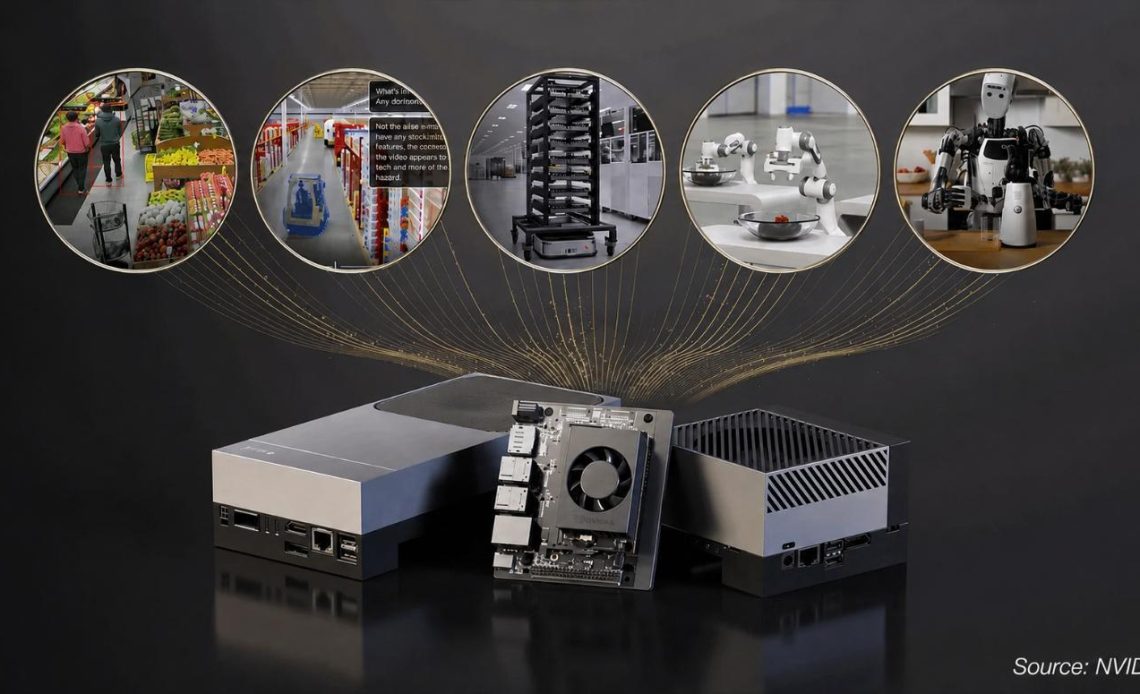
This has reshaped how vendors design hardware. NVIDIA now markets edge computing solutions specifically for enterprise, embedded, and industrial environments, positioning AI inference at the edge as a first-class workload rather than an afterthought. The company’s broader message, repeated across its 2025 and 2026 events, is that “AI factories” are becoming the new infrastructure of an intelligence era.
Hardware partners have moved quickly to match that vision. At NVIDIA GTC DC in October 2025, HPE announced an expanded portfolio of turnkey AI factory solutions built with NVIDIA. HPE described these as full-stack, private AI factories designed to help enterprises and governments scale AI quickly while staying compliant, citing research that nearly 60 percent of organizations have fragmented AI goals and lack comprehensive data management for AI. That fragmentation is exactly the problem edge-ready AI infrastructure aims to solve.
Key Benefits of Edge AI
- Faster AI inference close to where data is generated
- Lower latency for time-sensitive decisions
- Reduced bandwidth and cloud egress costs
- Better privacy for sensitive workloads
- The ability to run AI models even at disconnected sites
Why Real-Time Processing Matters
To understand why latency is such a big deal, it helps to think about what “real time” actually means in an enterprise setting. On a factory floor, a vision system inspecting parts on a conveyor belt has milliseconds to decide whether an item passes or fails. In a hospital, a monitoring system watching a patient’s vitals cannot pause to consult a cloud region halfway across the country. In these situations, the delay of sending data away and waiting for an answer is the difference between a system that works and one that does not.
Edge analytics addresses this by keeping the decision loop tight. Data is captured, processed, and acted upon locally, with only summaries or exceptions sent upstream. Dell put this in concrete terms when describing its manufacturing work, noting that edge infrastructure can reduce latency “from minutes to milliseconds” by processing data at the source. Dell’s NativeEdge platform enables real-time data processing at the source, ensuring data is actionable where it is generated.
That shift from minutes to milliseconds is not a minor optimization. For many use cases, it is the entire point.
Where Real-Time Processing Is Essential
- Automated quality inspection on production lines
- Safety systems that must react instantly
- Patient monitoring in healthcare settings
- Autonomous vehicles and robotics
- Fraud detection at the point of transaction
The Role of Private 5G
Distributed infrastructure needs a network to match, and this is where private 5G has become a serious enterprise topic. Public cellular networks are shared, unpredictable, and not built for the reliability that industrial operations demand. A private 5G network gives an organization its own dedicated wireless coverage across a factory, port, campus, or warehouse, with the low latency and high device density that edge workloads require.
The market has matured to the point where clear leaders have emerged. An Omdia review published in May 2025 placed Nokia at the top of private 5G vendors, ahead of ZTE and Ericsson, describing private wireless as a key enterprise 5G monetization opportunity. Omdia identified Nokia, ZTE, and Ericsson as leaders in the private 5G segment.
For infrastructure managers, private 5G and edge computing are two halves of the same strategy. The edge provides the local compute; private 5G provides the reliable, high-performance connectivity that ties those edge nodes to sensors, machines, and mobile devices.
Why Private 5G Complements the Edge
- Dedicated, reliable coverage across large sites
- Low latency suited to real-time workloads
- Support for large numbers of connected devices
- Better security through network isolation
- Consistent performance for mission-critical operations
Edge Computing in Manufacturing
Manufacturing is where many of these ideas come together first, and for good reason. Factories generate huge volumes of machine data, operate on tight tolerances, and lose real money every minute a line sits idle. They also face rising security pressure. Dell, referencing IBM’s 2024 X-Force Threat Intelligence Index, pointed out that manufacturing has become the most targeted industry for cyberattacks. According to IBM’s 2024 X-Force Threat Intelligence Index, manufacturing is now the most targeted industry for cyberattacks.
The typical entry point is predictive maintenance. Rather than replacing parts on a fixed schedule or waiting for something to break, manufacturers use edge analytics to watch equipment behavior and flag problems before they cause downtime. Once that first use case proves its value, teams tend to expand into quality control, supply chain optimization, and other areas. Dell describes exactly this phased pattern: start with a high-impact case like predictive maintenance, prove return on investment quickly, then scale across facilities.
The larger vision is the smart factory, where machines self-correct, vision systems catch defects humans would miss, and workers shift toward higher-value tasks. That future is still arriving, but the building blocks, edge compute, industrial IoT, and on-site AI, are already being deployed.
How Manufacturers Use the Edge
- Predictive maintenance to prevent unplanned downtime
- AI-driven visual inspection for quality control
- Real-time monitoring of production lines
- Supply chain and logistics optimization
- Keeping sensitive operational data on premises
Healthcare and Smart Infrastructure
Healthcare presents a different but equally compelling case. Hospitals and research facilities handle some of the most sensitive data that exists, and they often operate under rules that limit where that data can travel. Running AI inference locally lets them gain insight from imaging, monitoring, and diagnostics without exposing patient information to external networks.
This is not theoretical. Microsoft highlighted that pharmaceutical company GSK is using Azure Local to process real-time data and run AI inference across manufacturing and research facilities worldwide. GSK is using Azure Local to process real-time data and run AI inference across manufacturing and research facilities worldwide. It is a good example of how edge platforms let regulated organizations adopt AI without giving up control of their data.
The same logic extends to smart cities. HPE’s October 2025 announcement introduced an Agentic Smart City Solution, with the Town of Vail as its lighthouse customer, working with HPE and NVIDIA on projects that include permitting, accessibility compliance, and wildfire detection. HPE launched an Agentic Smart City Solution with the Town of Vail as its lighthouse customer, using its private cloud AI platform for wildfire detection, permitting, and accessibility compliance. Cities, like hospitals, need to move from isolated pilots to scaled deployments, and edge infrastructure is what makes that possible.
Where Healthcare and Smart Infrastructure Benefit
- Local AI inference that protects patient data
- Real-time monitoring in clinical settings
- Compliance with strict data residency rules
- Citywide services like safety and permitting
- Scaling from pilots to full deployments
Retail Transformation Through Edge
Retail may be the most visible example to everyday consumers, even if they never notice the technology. Modern stores are becoming data-rich environments, with computer vision handling checkout, inventory tracking, and shopper analytics. All of that works best when processing happens in the store, not in a distant cloud.
The appeal is straightforward. A store cannot afford for its systems to freeze because an internet link went down, and it does not want to stream constant video to the cloud just to count items on a shelf. Edge computing keeps those workloads local, fast, and resilient. HPE specifically called out retail among the industries that its private AI and digital assistant offerings are meant to serve, alongside manufacturing, healthcare, banking, and education.
For retail decision-makers, the edge is less about novelty and more about reliability and cost control across many locations.
How Retail Uses Edge Computing
- Frictionless and automated checkout
- Real-time inventory and shelf monitoring
- In-store analytics without heavy cloud costs
- Resilience when connectivity is unreliable
- Personalized experiences processed locally
Cybersecurity at the Edge
Distributing compute across dozens or hundreds of sites creates an obvious question: how do you secure it all? Each edge location is potentially another target, and the old model of defending a single network perimeter does not fit an environment where data and workloads are spread everywhere. This mirrors the broader challenge that hybrid IT has created across enterprise security more generally.
Vendors have responded by building security directly into edge platforms. HPE’s 2025 announcements leaned heavily on this theme, introducing air-gapped management that enables network-isolated environments for secure, compliant deployments, aimed at governments, sovereign entities, and regulated industries. HPE introduced air-gapped management that enables network-isolated cloud environments for secure, compliant deployments often required by governments, sovereign entities, and regulated industries.
Microsoft took a similar direction with identity and device security for its IoT platforms. Azure IoT Hub added X.509 certificate management for secure identity lifecycle control, with integration to Azure Device Registry to centralize identity, security, and policy management across device fleets. Securing a fleet of edge devices is as much about managing identities and policies at scale as it is about traditional network defense.
Priorities for Edge Cybersecurity
- Consistent security policies across many sites
- Strong device identity and certificate management
- Air-gapped options for regulated environments
- Local threat detection and response
- Centralized visibility across distributed nodes
Managing Distributed Infrastructure
If there is one lesson from the past two years of announcements, it is that unified management is the real battleground. Edge computing only works at scale if IT teams can deploy, monitor, and update thousands of nodes without visiting each one. Nobody wants to manage a fleet of edge sites the way they once managed individual servers.
This is why platforms emphasize centralized control. Microsoft’s Azure Arc extends a single management layer across on-premises, edge, and even other clouds. Microsoft added a new Google Cloud connector that allows GCP resources to appear in Azure for unified governance across Azure, AWS, and GCP, along with a site manager that organizes resources by physical location for distributed monitoring. Dell’s approach with NativeEdge similarly focuses on orchestrating AI applications across any location from a single point.
The pattern is consistent across vendors: the winning edge strategy is one that feels centralized to operate even though it is physically distributed.
What Distributed Management Requires
- Single-pane visibility across all sites
- Automated deployment and updates at scale
- Consistent policy enforcement everywhere
- Support for hybrid and multi-cloud estates
- Reliable operation during connectivity loss
Why Data Sovereignty Is Becoming Important
Data sovereignty has quietly become one of the strongest drivers of edge adoption. Governments and regulated industries increasingly insist that certain data stay within specific borders or systems, and cloud-only architectures struggle to guarantee that. Edge computing, by keeping data local, offers a cleaner answer.
This theme runs through nearly every recent enterprise announcement. HPE built much of its 2025 messaging around sovereign AI, supporting NVIDIA’s AI Factory for Government reference design and rolling out sovereign AI factory deployments with partners like the University of Utah and the State of Utah. Microsoft, similarly, positioned Azure Local for organizations that must retain sensitive data on premises and operate under strict sovereignty requirements.
For CIOs in finance, government, healthcare, and defense, sovereignty is no longer a compliance checkbox. It is shaping architecture decisions from the start.
Why Data Sovereignty Drives Edge Adoption
- Regulations requiring data to stay within borders
- Growing interest in sovereign AI infrastructure
- Sensitive workloads that cannot leave the premises
- Government and defense compliance requirements
- Local processing that simplifies audits
Challenges Organizations Must Solve
None of this is effortless. Edge computing introduces real complexity, and leaders who underestimate it tend to struggle. Managing hardware across many locations, keeping software consistent, and securing a wider attack surface all demand new skills and processes.
There is also the human factor. Dell’s own guidance stresses that technology alone does not build smart factories, and that upskilling programs and cross-functional alignment are essential to make edge and AI initiatives succeed. The gap between a promising pilot and a scaled deployment is often organizational rather than technical.
Cost and vendor lock-in deserve attention too. Edge platforms are powerful, but tightly integrated stacks can be hard to move away from later. Thoughtful architecture, favoring cloud-native and open standards where possible, helps preserve flexibility.
Common Edge Computing Challenges
- Managing hardware across many physical sites
- A larger and more varied attack surface
- Skills gaps in distributed AI operations
- Risk of vendor lock-in with integrated stacks
- Moving from pilot projects to full scale
How Enterprises Should Prepare
The practical path forward is less dramatic than the headlines suggest. Successful organizations tend to start narrow and expand. They pick one high-value use case, prove it works, measure the return, and then repeat. Dell’s recommended sequence, assess and align, deploy edge infrastructure, integrate AI, empower the workforce, then scale, captures this discipline well. Dell advises a phased approach: assess and align, deploy edge infrastructure, integrate AI solutions, empower the workforce, then scale and optimize.
Beyond the sequence, leaders should insist on unified management from day one, plan security into the design rather than bolting it on, and think carefully about where data must live. The organizations that treat edge as an extension of their overall infrastructure strategy, not a separate science project, tend to move faster and stumble less.
Steps to Prepare for the Edge
- Start with one clear, high-value use case
- Prove return on investment before scaling
- Build unified management in from the beginning
- Design security and sovereignty into the architecture
- Invest in workforce skills alongside technology
The Future of Enterprise Edge Computing
Looking ahead, the direction is clear even if the timeline is not. AI inference will keep moving closer to where data is created. Agentic AI, systems that act on their own within defined limits, will increasingly run at the edge, closing the loop between sensing and action without human intervention. The vendor announcements of 2025 and 2026 read almost like a shared roadmap toward this reality.
What makes this moment different from earlier edge hype is that the pieces now fit together. Powerful, efficient hardware, mature private 5G, unified management platforms, and a genuine business need created by AI have arrived at roughly the same time. That convergence is what turned edge computing from an interesting idea into an infrastructure priority.
Enterprises that build this capability now will be positioned to adopt whatever comes next. Those that wait may find themselves retrofitting under pressure.
What to Expect from Enterprise Edge
- More AI inference running directly at the edge
- Growth of agentic AI in physical environments
- Tighter integration of edge, cloud, and 5G
- Stronger emphasis on sovereign and private AI
- Edge treated as core infrastructure, not an add-on
Closing Thoughts
Edge computing has reached a turning point. The pull of AI, the reality of data sovereignty, and the simple physics of latency have combined to make distributed infrastructure a strategic necessity rather than a technical curiosity. The announcements from NVIDIA, HPE, Dell, and Microsoft over the past year are not isolated product news; they are signs of an industry reorganizing itself around intelligence that lives everywhere.
For CIOs, CTOs, and infrastructure leaders, the message is practical. Start small, prove value, manage centrally, and design for security and sovereignty from the outset. The enterprises that treat the edge as a natural extension of their cloud and network strategy will be the ones ready to compete as AI works its way into every corner of the business.