
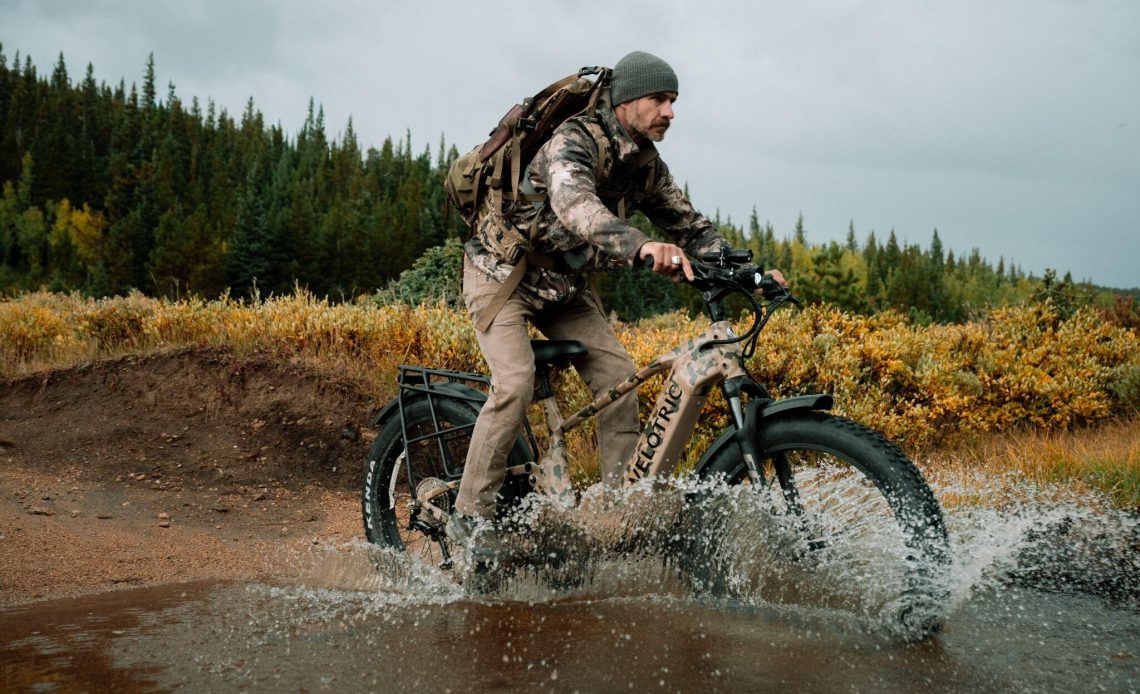
Hunting often begins long before a hunter reaches a stand, blind, or scouting location. Getting there can mean traveling along forest roads, crossing uneven ground, climbing hills, and carrying equipment farther than expected.
Traditionally, hunters have relied on walking, trucks, ATVs, and other off-road vehicles for this part of the trip. Each option has advantages, but electric bikes are creating another way to approach backcountry transportation.
A modern hunting ebike combines electric assistance with the mobility of a bicycle, giving riders a practical option for covering longer access routes while carrying equipment. Improvements in motors, batteries, suspension, fat tires, and cargo systems are also making these bikes increasingly capable away from pavement.
The result isn’t simply a faster bicycle. For some hunters, an ebike can change how they think about access, scouting, and transportation in the field.
Why Transportation Matters During a Hunt
Distance can become a significant part of hunting.
A promising location may be several miles from a parking area, and the route itself can require considerable effort before the actual hunt begins. Carrying a pack and other equipment makes that journey more demanding.
Walking remains one of the simplest ways to access remote areas, but covering several miles on foot takes time and energy. Motor vehicles can cover ground more efficiently where they’re permitted, although their size and engine noise make them less suitable for some routes.
Electric bikes occupy an interesting space between these options.
Pedal assistance can reduce the physical effort required to cover longer distances while the relatively compact format of a bicycle allows riders to travel on suitable routes that would be awkward for larger vehicles.
This combination has helped make ebikes increasingly relevant to hunters and other outdoor users.
Electric Assistance Makes Longer Access Routes More Practical
One of the biggest changes brought by electric bikes is the ability to assist the rider rather than replace riding entirely.
The rider still pedals, but the motor reduces the effort needed to maintain momentum or climb hills. This becomes particularly useful when the bike is carrying additional equipment.
Motor specifications are therefore an important consideration on a hunting ebike.
A commuter riding mostly on pavement may prioritize efficiency and low weight. Hunters are more likely to encounter loose surfaces, elevation changes, and heavier loads, making usable torque and consistent power more important.
The Velotric Nomad 2X provides an example of how modern fat tire ebikes are being designed around these conditions. Its 750W rear-hub motor reaches 1,400W of peak output and produces up to 105 Nm of torque.
That additional support can be useful when a route becomes steeper or when the bike is carrying more equipment than it would during an ordinary recreational ride.
Full Suspension Is Becoming More Relevant Off the Road
Motor power solves only part of the problem.
Forest roads and outdoor access routes aren’t consistently smooth. Ruts, rocks, roots, depressions, and repeated small impacts can make a long ride uncomfortable even when the motor has more than enough power.
This is why suspension has become increasingly important on outdoor-oriented ebikes.
Front suspension can reduce impacts reaching the handlebars, but a full-suspension system also allows the rear wheel to respond to uneven terrain.
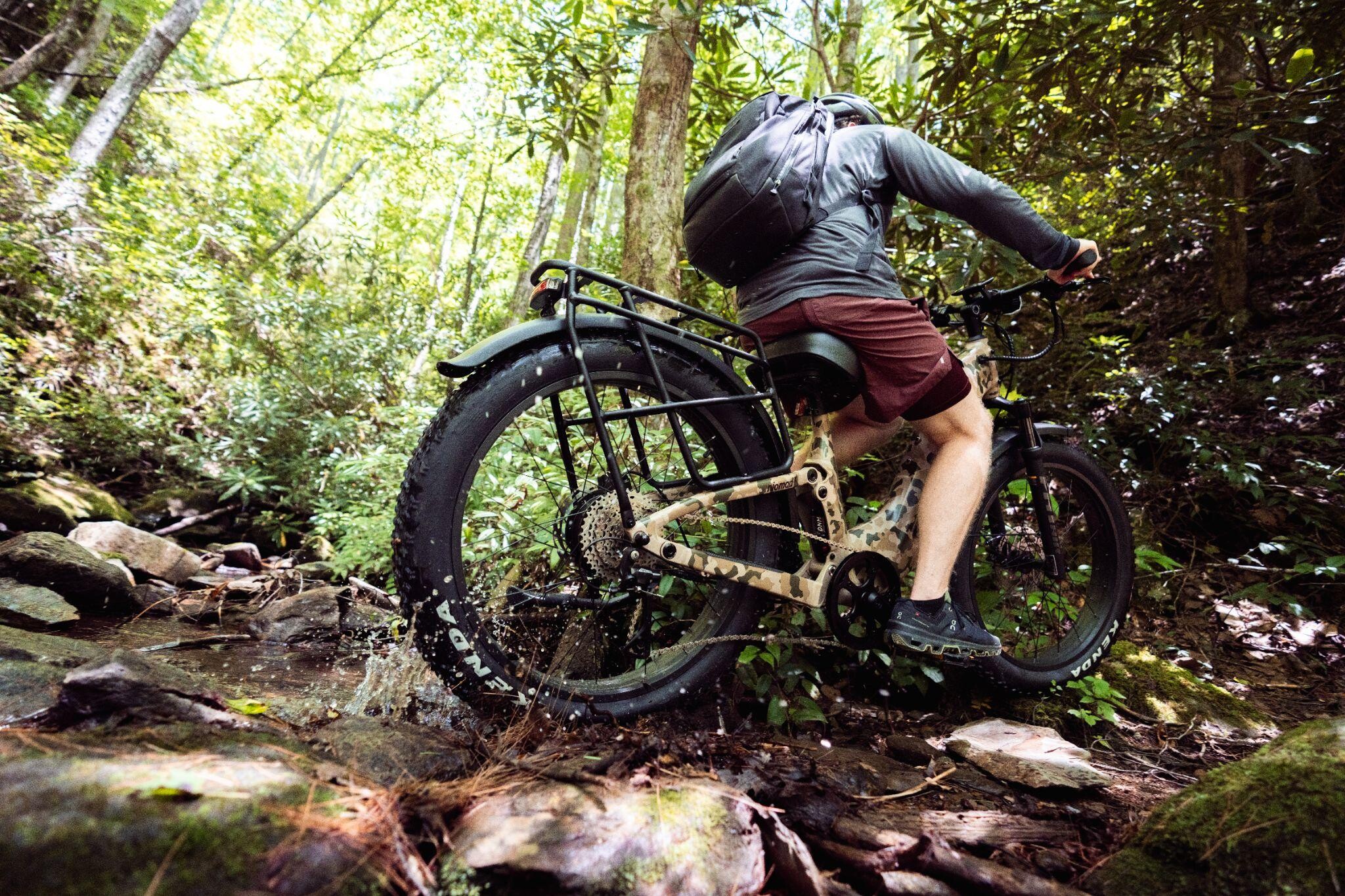
On the Nomad 2X, a 120 mm front air fork is paired with 80 mm of rear-wheel travel. Rather than relying on large tires alone to soften rough surfaces, the suspension helps the bike manage larger and repeated impacts.
For hunters traveling several miles before reaching their destination, this can make rough access roads considerably more manageable.
Why Fat Tires Still Matter
Fat tires have become closely associated with hunting and all-terrain ebikes for a reason.
A wider tire creates a larger contact area with the ground and can provide greater stability when the surface becomes loose or inconsistent. This can be useful on dirt roads, gravel, soft soil, and other unpaved surfaces commonly encountered outdoors.
The Nomad 2X uses 26 × 4.0-inch puncture-resistant tires, giving it the broad footprint expected from an all-terrain fat tire design.
However, tire width shouldn’t be viewed in isolation.
A capable hunting ebike works best when its tires, suspension, motor, and braking system support one another. Fat tires can improve traction and absorb smaller surface irregularities, while suspension takes on impacts that tire volume alone can’t comfortably manage.
Carrying Equipment Changes What an Ebike Needs to Do
Hunting transportation isn’t only about moving the rider.
Packs, clothing, food, optics, tools, and other outdoor equipment can quickly add weight. Depending on the trip, a rider may also need a rack, bags, or a compatible trailer.
This changes the requirements of the bike.
Payload capacity, rack compatibility, braking performance, and frame stability become more important than they might be on a lightweight recreational ebike.
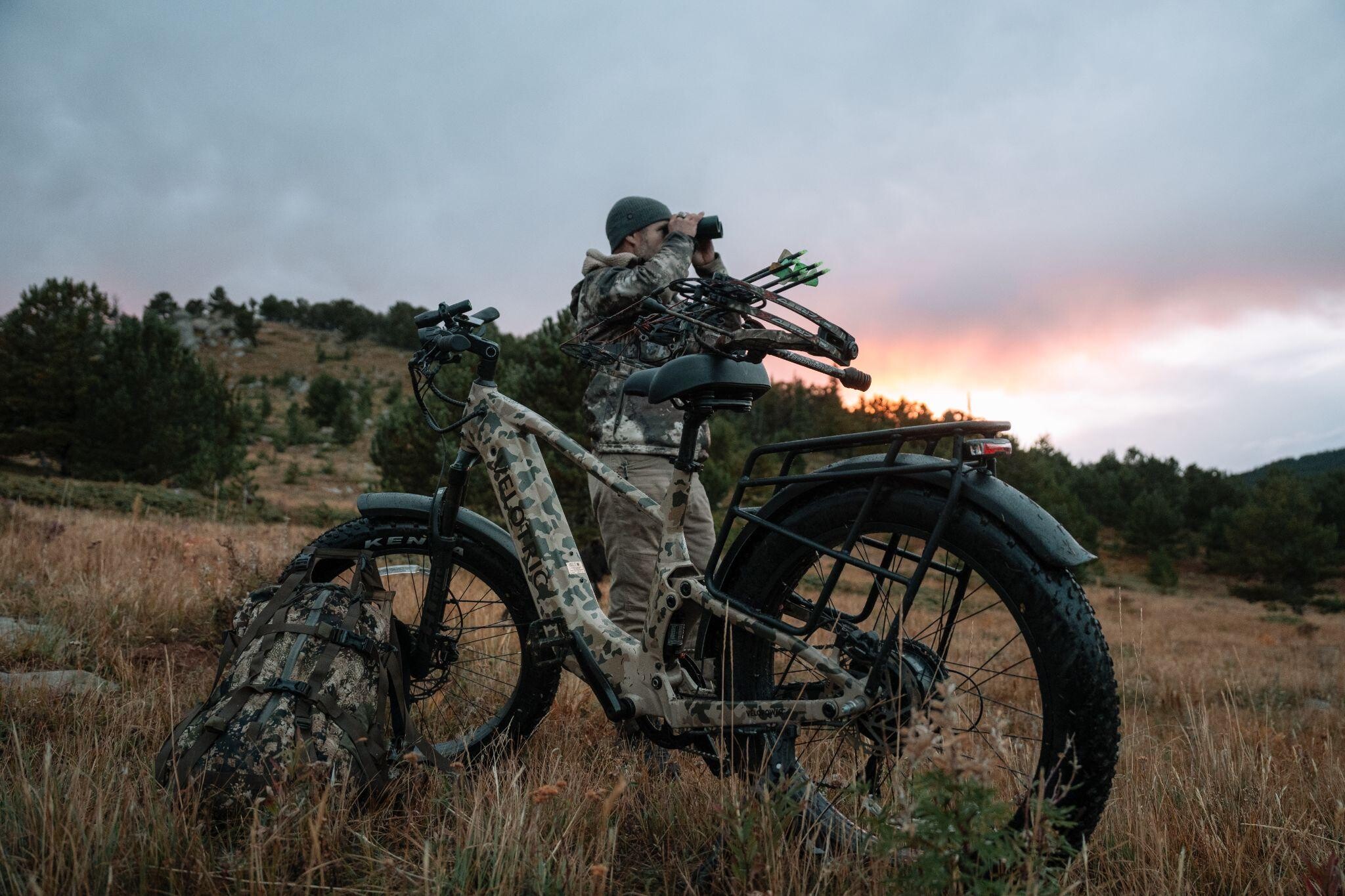
The Nomad 2X has a maximum payload capacity of 560 pounds and supports up to 120 pounds on its rear rack. For compatible towing configurations, it’s rated for towing loads up to 1,000 pounds.
These numbers illustrate a broader direction in hunting ebike design: the bike is increasingly being treated as an equipment platform rather than transportation for the rider alone.
Actual carrying and towing setups still need to account for the trailer, terrain, load distribution, braking distance, and manufacturer guidance.
Quiet Mobility Can Be an Advantage
Noise is another reason electric transportation has attracted attention in outdoor applications.
Gas-powered vehicles generate continuous engine noise that can travel through otherwise quiet environments. Electric motors operate very differently and can provide assistance with substantially less mechanical noise.
For hunting access, this doesn’t make an ebike silent. Tires still move over leaves and gravel, chains and components produce some sound, and the rider remains part of the environment.
However, reducing continuous engine noise can make an electric bike a more natural fit for low-profile outdoor travel.
Some hunting-oriented designs take this idea further. The Nomad 2X, for example, includes a Stealth Mode intended for quieter, lower-profile riding.
This reflects how ebike development is moving beyond basic transportation specifications and toward features designed for particular outdoor activities.
Range Requires More Planning Away From Home
Battery range becomes especially important when an ebike is used farther from convenient charging.
Manufacturers typically provide estimated maximum ranges, but actual distance depends on conditions such as rider and cargo weight, elevation, temperature, terrain, tire pressure, speed, and the amount of motor assistance being used.
For hunters, the return journey matters just as much as the ride in.
A route that feels easy with a fresh battery may become more demanding after several hours outdoors, particularly if the return trip involves additional weight.
The Nomad 2X has a claimed pedal-assist range of up to 75 miles. That provides considerable flexibility for longer outings, but riders should still treat published range figures as planning references rather than guaranteed distances.
Keeping a reasonable battery reserve is particularly useful when exploring unfamiliar terrain.
A Different Kind of Outdoor Mobility
The growing interest in hunting ebikes is part of a larger change in electric transportation.
Early ebikes were often associated primarily with commuting and recreational cycling. As motors, batteries, frames, suspension systems, and cargo components have improved, manufacturers have been able to design bikes for increasingly specialized environments.
Hunting is one example.
Instead of optimizing only for paved-road efficiency, an outdoor-focused ebike can prioritize traction, suspension, carrying capacity, range, and controlled power.
Models such as the Velotric Nomad 2X show how these technologies can come together in one platform. Its combination of a high-torque motor, fat tires, full air suspension, substantial payload capacity, and outdoor-focused features makes it representative of where this category is heading.
The important development isn’t any single specification. It is the way these systems work together to make electric bikes useful in environments that were once dominated by walking or larger motorized vehicles.
Final Thoughts
Technology is changing the way people move through outdoor environments, and electric bikes are becoming part of that shift.
For hunters, the value of an ebike goes beyond speed. Electric assistance can help conserve energy on longer approaches, while fat tires, suspension, and cargo capability allow modern bikes to operate more effectively on rougher routes.
Purpose-built models such as the Velotric Nomad 2X demonstrate how far the category has developed. Features once associated with separate types of outdoor equipment are increasingly being combined into a single electric bike designed for changing terrain and heavier demands.
The most useful hunting ebike isn’t simply the one with the largest motor or widest tires. It is one whose power, range, suspension, traction, and carrying capability work together for the conditions a rider actually expects to encounter.
As these technologies continue to improve, electric bikes are likely to become an increasingly familiar part of how hunters and other outdoor enthusiasts explore farther while using their energy where it matters most.