
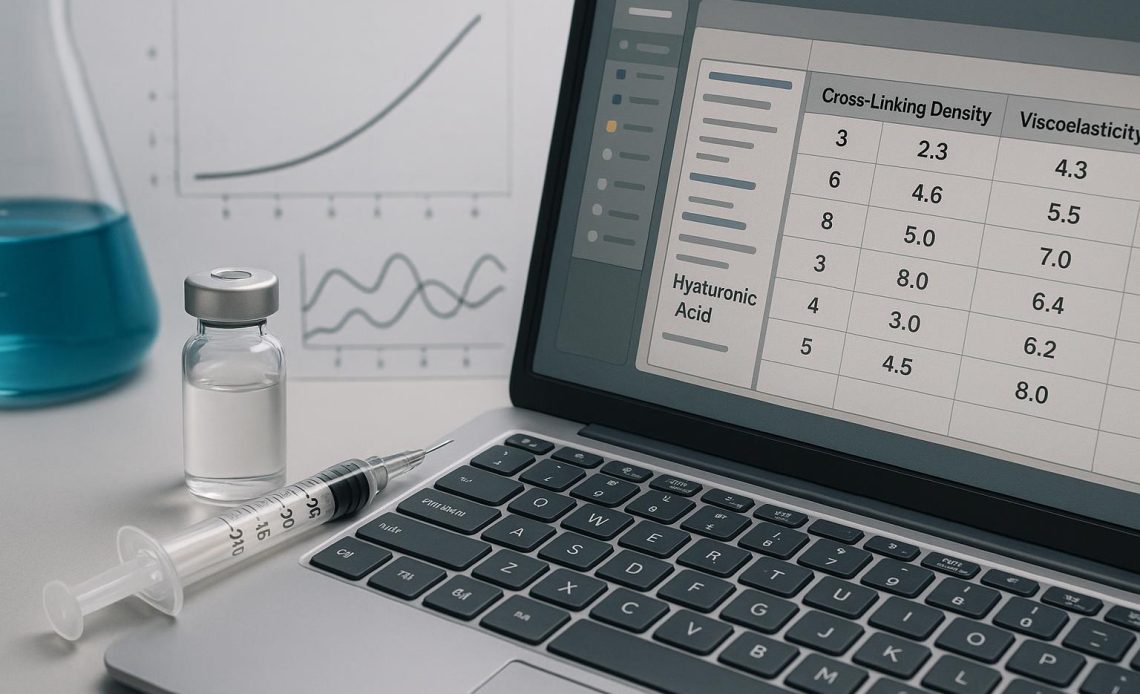
Achieving predictable vector lift in the lower third of the face requires a firm grasp of rheological behavior under mechanical stress. When treating structural deficiencies of the chin and mandibular angle, clinicians cannot rely on total hyaluronic acid (HA) concentration alone. Two gels with an identical 24 mg/mL concentration can act completely differently once implanted against the periosteum.
The difference lies in how polymer chains are bound, how much water the network holds, and how the final gel responds to both vertical compression and lateral shearing forces.
For injectors and procurement managers selecting products for deep structural work, understanding these physical properties is essential. Getting it wrong doesn’t just mean a disappointed patient who lost their sharp jawline in three months. It can mean product displacement, late-onset inflammatory reactions, or localized water retention that blunts the very contours you tried to create.
The Mechanical Demands of the Mandibular Region
The lower third presents a harsh mechanical environment. Unlike the soft, mobile tissue of the lips or the midface fat pads, tissues overlaying the mentum and mandibular angle are subjected to continuous muscular forces. The mentalis, depressor anguli oris, and masseter muscles exert significant shear and compressive stress on any implanted material.
To resist these forces, a gel targeted for deep subperiosteal placement must possess high elastic modulus (G′). Elastic modulus measures the amount of energy a gel can store under deformation and recover once the force is removed—in plain terms, its firmness. A high G′ prevents the bolus from flattening out under the weight of overlying soft tissue and mentalis contraction.
However, G′ only tells half the story.
A gel can be firm yet crumble under stress if it lacks cohesivity—the intermolecular forces that hold the cross-linked network together. Low-cohesivity gels, even those with high elastic values, risk fragmenting or migrating away from the periosteum into superficial planes over time.
Polymer Cross-Linking and Extrusion Dynamics
The manufacturing process determines how these rheological properties play out in clinic. Most modern HA dermal fillers use 1,4-butanediol diglycidyl ether (BDDE) as a cross-linking agent. BDDE forms covalent bonds between uncoiled HA monomer strands, creating a three-dimensional matrix that slows down breakdown by endogenous hyaluronidase.
The modification degree—the ratio of bound BDDE molecules to total HA monomer units—directly alters the physical profile:
- High Modification Degree: Yields a tighter matrix with extended degradation times, but can increase the risk of hydrophilic swelling or delayed-type hypersensitivity if residual unreacted BDDE isn’t fully washed out during purification.
- Low Modification Degree: Produces a softer matrix that integrates rapidly into native tissue, but offers less resistance to mechanical compression.
- Monophasic vs. Biphasic Structuring: Biphasic gels contain cross-linked HA particles suspended in a non-cross-linked HA fluid carrier, providing high G′ but requiring careful extrusion techniques. Monophasic gels feature a continuous cross-linked network that typically yields smoother extrusion forces through thin-walled needles.
When clinical directors build product protocols, they must balance these chemical variables against practical procurement considerations. Selecting a high-density, monophasic BDDE-crosslinked gel provides the structural capacity needed for bony contact without sacrificing flow dynamics.
Clinics looking to secure stable stock of uniform monophasic formulations often turn to established supply channels where they can source authentic Revolax for your practice to maintain consistency in deep-tissue structural protocols. Reviewing a product line’s specific rheological specifications allows medical directors to verify that the cross-linking profile aligns with their technique for mandibular and chin augmentation.
Having reliable access to authentic, well-characterized gels keeps clinical results consistent across different providers within the same facility.
Rheological Parameters for Lower-Third Fillers
When auditing inventory or evaluating new product lines for structural indication, use this breakdown of physical metrics to categorize gels based on their performance under stress:
Elastic Modulus (G′)
- Target Range: High (> 320 Pa)
- Too Low: Lack of projection; product flattens into surrounding tissue within weeks.
- Too High: Excessively stiff feel; unnatural appearance during facial movement if placed too superficially.
Viscous Modulus (G′′)
- Target Range: Moderate (30–60 Pa)
- Too Low: Poor flow properties; high extrusion pressure needed during delivery.
- Too High: Gel behaves like a liquid; loses shape almost immediately after injection.
Loss Factor (tanδ)
- Target Range: Low (< 0.20)
- Too Low: Gel is overly rigid; reduced capacity to absorb repetitive muscular micro-shocks.
- Too High: Matrix is overly fluid; poor structural integrity under dynamic load.
Cohesivity
- Target Range: High
- Too Low: Product fragments under shear stress; risk of lateral migration into adjacent compartments.
- Too High: Product holds together so tightly it resists integration, forming discrete, palpable nodules.
Swelling Ratio
- Target Range: Low to Moderate
- Too Low: Inadequate local hydration, leading to suboptimal volume restitution.
- Too High: Excessive water draw over 48–72 hours; loss of crisp definition at the jawline.
Common Selection Mistakes in Lower-Third Augmentation
Even experienced injectors fall into predictable traps when picking materials for jawline and chin contouring:
1. Substituting Volume for Firmness
Injecting a larger volume of a low G′ filler to achieve projection is a frequent error. A softer gel will simply spread horizontally across tissue planes, blunting the mandibular angle rather than defining it. Volume cannot compensate for a lack of structural shear resistance.
2. Underestimating Muscular Displacement
The mentalis muscle exerts significant pressure on the chin. Placing a low-cohesivity gel in a supra-periosteal pocket without accounting for muscle strain leads to product displacement into the labiomental fold or down toward the submental space.
3. Misjudging the Swelling Factor
Gels with a high proportion of free, uncross-linked HA draw significant water in the first few days post-injection. In the jawline, this water draw transforms what looked like a crisp contour on the table into a soft, puffy appearance within a week.
4. Overlooking Injection Force Mechanics
A gel with high physical resistance requires high pressure to push through a standard 27G needle. If extrusion force isn’t smooth, the injector loses fine thumb control, raising the risk of placing an uneven bolus or injecting too quickly near vascular structures.
Step-by-Step Decision Framework for Selection
- Assess Anatomical Plane & Cover Thickness: Thick soft tissue overlay requires higher G′. Thin dermal envelopes require lower G′ and higher tissue integration.
- Evaluate Muscular Activity at Target Site: High muscle strain (Chin/Angle) demands high cohesivity. Static planes (Temporal fossa) tolerate lower cohesivity.
- Check Product Swelling Ratio: Select low water-draw gels for sharp, crisp margins. Reserve hydrophilic gels for diffuse volume loss.
- Confirm Delivery Instrument Compatibility: Match gel viscosity to needle or cannula gauge to ensure smooth, predictable extrusion force.
Practical Considerations and Safety Controls
Matching rheology to anatomical depth isn’t just about aesthetic longevity—it is a critical safety consideration. Placing high G′, highly cohesive gels in superficial layers can cause visible product outlines, delayed inflammatory nodules, and long-term asymmetry. Conversely, placing low G′ soft gels deep on the bone wastes material and disappoints patients.
Storage conditions matter, too. Hyaluronic acid chains are sensitive to temperature spikes. Storing product in environments outside the manufacturer’s recommended range (2∘C to 25∘C) can degrade the cross-linked network before it ever enters a syringe, dropping its effective G′ and shortening its in-tissue longevity.
Practices should track lot numbers alongside patient records to monitor performance. If a specific batch shows unusual resistance during delivery or seems to yield inconsistent tissue retention, the clinical team can cross-reference the manufacturer’s Certificate of Analysis to verify that cross-linking density and G′ fall within standard manufacturing tolerances.
Matching product physics to tissue dynamics turns lower-third facial contouring from a guessing game into a repeatable science. When you respect the relationship between shear modulus, cohesivity, and muscular strain, structural results stay right where you put them.
Frequently Asked Questions
What is the difference between elastic modulus (G′) and viscous modulus (G′′)?
Elastic modulus (G′) measures the solid-like, elastic behavior of a gel—its ability to resist deformation and provide structural lift. Viscous modulus (G′′) measures the fluid-like behavior—how the gel flows under stress. A higher G′ relative to G′′ means a firmer, more supportive filler.
Why is cohesivity critical for chin and jawline fillers?
Cohesivity keeps the cross-linked gel network intact under dynamic tissue movement. In the lower third, muscle contraction exerts continuous shear stress. High cohesivity prevents the filler bolus from breaking apart or migrating away from the bone into superficial soft tissue.
How does cross-linking density affect dermal filler longevity?
Cross-linking binds individual HA chains into a complex matrix using agents like BDDE. A higher cross-linking density slows down breakdown by body enzymes (hyaluronidase), helping the gel last longer in high-movement areas. However, it must be balanced to avoid excessive stiffness or unexpected water retention.