
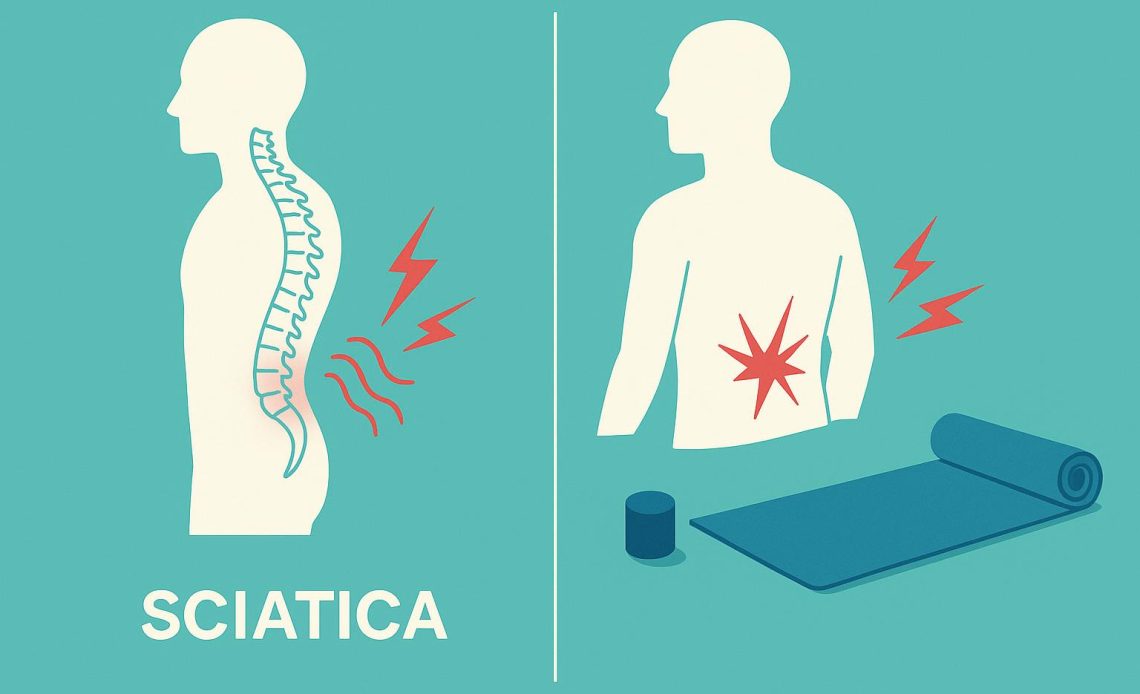
At our Kanata clinic, we hear the word “sciatica” used constantly by new patients. Often, someone will come into Kinoveo clutching their lower back, saying they tweaked it shoveling heavy Ottawa snow or deadlifting at the gym, and now their “sciatica is acting up.”
Because the term has become a catch-all for any severe lower back issue, it leads to a lot of confusion. But in the medical world, general lower back pain and true sciatica are two entirely different animals. They have different causes, they behave differently, and most importantly, they require completely different treatment strategies to fix.
If you are currently dealing with a painful back, here is how to tell exactly what you are dealing with, and what you need to do to actually resolve it.
General Mechanical Lower Back Pain: The Localized Ache
When physiotherapists talk about “general” or “mechanical” lower back pain, we are referring to pain that originates from the moving parts of your spine. Your lower back (the lumbar spine) is a complex structure made of vertebrae, shock-absorbing discs, facet joints, ligaments, and thick layers of muscle.
When you overload these structures, whether through a sudden, awkward movement, poor lifting mechanics, or simply sitting hunched over a desk in the Kanata tech park for fifty hours a week, the tissues react. You might sustain a minor muscle strain, sprain a ligament, or irritate the facet joints that guide the movement of your spine.
How Mechanical Back Pain Feels:
- It stays local: The pain generally stays confined to the lower back itself, right across the belt line. Sometimes it might refer slightly down into the upper glutes, but it rarely travels past the crease of your buttocks.
- It feels dull or grabbing: Patients usually describe mechanical pain as a deep, dull ache, severe stiffness, or a “grabbing” sensation when they try to change positions, like standing up from a chair.
- It is positional: It usually feels better when you find a comfortable resting position and worse when you move the injured tissue.
True Sciatica: The Electrical Fire
Sciatica is not actually a medical diagnosis; it is a symptom. The clinical term is lumbar radiculopathy.
You have a massive nerve, the sciatic nerve, that starts in your lower back. It is formed by nerve roots that exit your spinal cord, merge together, and travel deep through your glutes and all the way down the back of each leg to your toes. At its thickest point, the sciatic nerve is about the width of your thumb.
True sciatica happens when one of those nerve roots in your lower back gets compressed, pinched, or chemically irritated. The most common culprit is a bulging or herniated disc pressing directly against the nerve root. Because nerves are the electrical wiring of your body, when you pinch the wire at the source (the spine), the brain perceives pain along the entire length of that wire (the leg).
How True Sciatica Feels:
- It travels: The hallmark of sciatica is pain that radiates past the glutes, down the back of the thigh, and often past the knee into the calf or foot.
- It feels electrical: Unlike the dull ache of a muscle strain, nerve pain is sharp. It is frequently described as burning, searing, or feeling like an electrical shock shooting down the leg.
- It brings neurological symptoms: Because a nerve is being compressed, you will often experience numbness, “pins and needles” tingling, or actual muscle weakness in your leg or foot.
Why the Distinction Matters for Your Recovery
This is where self-diagnosing on the internet gets people into trouble. If you have a stiff, strained muscle in your back, intuitively, you want to stretch it. Stretching an injured muscle or mobilizing a stiff joint can encourage blood flow and provide relief.
But if you have true sciatica, stretching is often the absolute worst thing you can do.
Think of an irritated nerve like a frayed rope. If you try to aggressively stretch your hamstrings to relieve the “tightness” in the back of your leg, you are essentially pulling that frayed nerve completely taut against the disc or bone that is compressing it. This will make the nerve significantly angrier and delay your healing. You cannot stretch a nerve the way you stretch a muscle; it just pisses the nerve off.
The Physiotherapy Approach: Fixing the Root Cause
Whether you are dealing with mechanical back pain or radiating sciatica, resting in bed for weeks is outdated advice that actually leads to worse long-term outcomes. Your spine needs to move to heal. A targeted physiotherapy assessment allows us to pinpoint exactly which structure is failing.
Treating Mechanical Back Pain
If your pain is muscular or joint-related, our goal is to restore normal movement and build resilience.
- Manual Therapy: We use hands-on techniques to unlock stiff spinal segments and release muscle spasms that are guarding the area.
- Core Stabilization: We don’t just give you generic sit-ups. We teach you how to properly brace your deep core (the transversus abdominis) to act as an internal weight belt, protecting your lumbar spine during daily activities.
- Load Management: We figure out why the tissue failed in the first place, whether it’s poor lifting technique or prolonged sitting, and build a strengthening program so it doesn’t happen again.
Treating Sciatica
If you have nerve compression, the immediate goal is to take the pressure off the nerve root.
- Directional Preference (The McKenzie Method): We test different repeated movements to find a specific direction (often extending backward) that pushes the bulging disc material away from the nerve. When we find the right direction, the pain will actually start to retreat up the leg and back toward the spine, a process called centralization.
- Nerve Glides (Flossing): Instead of stretching the irritated nerve, we use specific, gentle movements called nerve glides to help the nerve slide smoothly through its sheath without snagging on surrounding tissues.
- Decompression Techniques: We use manual traction and specific positioning to open up the spaces where the nerves exit the spine, providing immediate relief from that burning, shooting pain.
Don’t Guess When It Comes to Your Spine
Back pain is exhausting, and nerve pain is terrifying, but both are highly treatable when you have the right diagnosis. You don’t have to navigate it alone or guess which stretches to do on YouTube.
If you are dealing with a stubborn ache in your lower back or shooting pain down your leg, book an assessment with us at Kinoveo Physio in Kanata. Let’s figure out exactly what is going on mechanically, calm the symptoms down, and build a plan to keep your spine resilient for the long haul.