
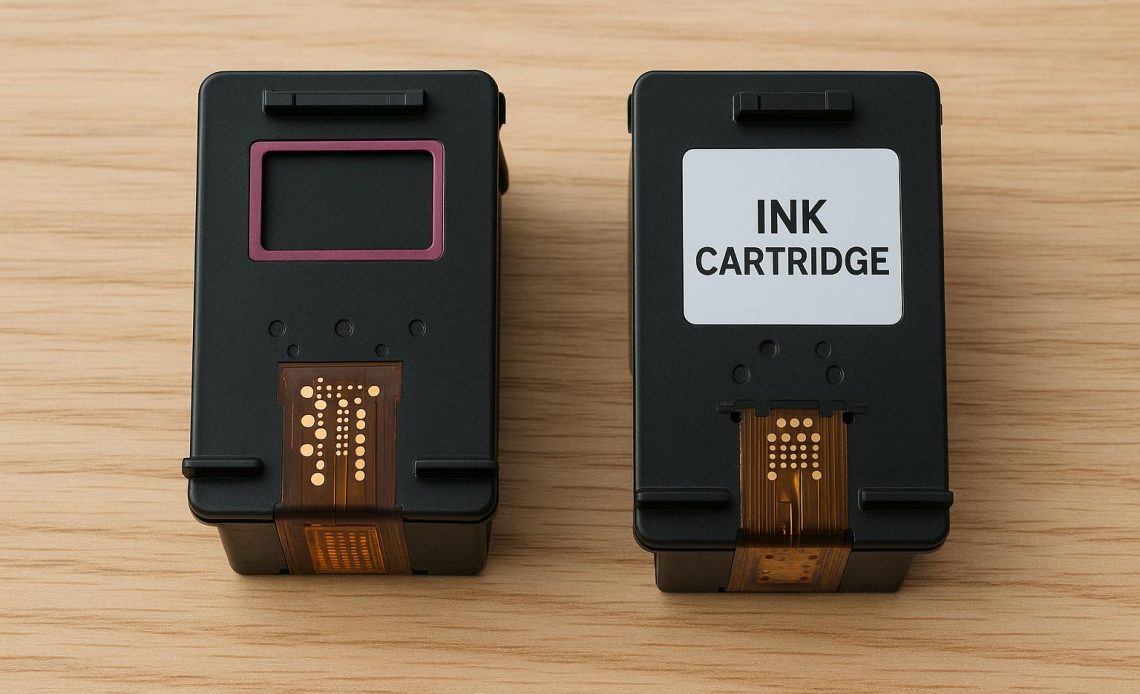
Anyone who has priced out replacement ink or toner has run into the sharp gap between OEM (original equipment manufacturer) cartridges and their remanufactured or compatible alternatives — often 30-50% cheaper. That price gap raises an obvious question: is the cheaper option actually a worse product, or is the difference mostly brand markup?
What “Remanufactured” Actually Means
A remanufactured cartridge is an original OEM cartridge that has been collected after use, disassembled, cleaned, inspected for damage, refilled with ink or toner, and had worn components (like print heads on some inkjet cartridges) replaced as needed before being resold. This is different from a “compatible” or “generic” cartridge, which is an entirely new cartridge manufactured by a third party to fit a specific printer model without reusing OEM parts. The two terms are sometimes used loosely or interchangeably in casual conversation, but they describe genuinely different manufacturing processes with different quality implications.
Why Printer Manufacturers Discourage Both
Printer manufacturers generally profit far more from ink and toner sales than from the printers themselves — a well-documented business model sometimes described as a “razor and blades” strategy, where the initial hardware is sold at a thin margin (or even a loss) in order to drive recurring, higher-margin supply purchases. This is the primary financial incentive behind manufacturer messaging that discourages third-party cartridges, and it’s worth understanding as context when evaluating manufacturer warnings about “using genuine cartridges only.”
What Independent Testing Has Actually Found
Consumer Reports has conducted comparative testing between OEM and remanufactured or compatible cartridges over the years, and its findings have generally shown that quality varies considerably by brand and specific cartridge — some remanufactured or compatible products perform comparably to OEM cartridges in print quality and yield, while others underperform meaningfully, particularly on color accuracy and print head compatibility for older or lower-quality third-party products. This is the most important nuance in the whole debate: “remanufactured” or “compatible” isn’t a single category with a uniform quality level, and treating it as either universally fine or universally inferior misses how much variation exists between suppliers.
Where Remanufactured Cartridges Tend to Perform Well
Toner cartridges for laser printers, in particular, tend to remanufacture more reliably than inkjet cartridges, since toner is a dry powder rather than a liquid subject to clogging or drying issues, and the core mechanical components (drum, wiper blade) can be more straightforwardly inspected and replaced during the remanufacturing process. This is part of why office and business printing environments — which more commonly use laser printers — often see fewer quality complaints with remanufactured supplies than home inkjet users sometimes report.
Does Using Non-OEM Cartridges Void a Printer Warranty?
In the U.S., the Magnuson-Moss Warranty Act generally prohibits manufacturers from voiding an entire product warranty simply because a consumer used a third-party part or supply, unless the manufacturer can demonstrate that the specific third-party product actually caused the damage in question. This is a common point of confusion, since manufacturer language sometimes implies broader consequences than the law actually allows. A cartridge that damages a printer could still void coverage for that specific damage, but using a compatible cartridge doesn’t automatically forfeit warranty protection on the entire device.
Practical Factors That Affect Real-World Results
Storage and shelf life matter. Remanufactured cartridges that have been sitting in inventory for a long time, or stored in poor conditions, can underperform regardless of the manufacturing process quality.
Not all suppliers use the same standards. Remanufacturing quality depends heavily on the specific supplier’s inspection and refilling process, which is why sourcing from an established, quality-focused supplier tends to produce more consistent results than the cheapest option available.
Printer age and model compatibility matter. Some printer models are more sensitive to non-OEM cartridges due to specific chip or sensor requirements, which can affect print quality or cause error messages even with a well-made compatible product.
For businesses trying to navigate these tradeoffs without extensively researching individual cartridge brands themselves, specialty retailers that focus specifically on remanufactured and compatible supplies — rather than treating it as a side product — can offer more consistent quality control than a broad discount retailer. Cartridge World Wichita, one of the ink and printing supply stores in Wichita area residents can turn to, positions its remanufactured cartridge selection around this kind of quality-focused sourcing, which reflects the broader point that not all non-OEM suppliers should be evaluated the same way.
The Bottom Line
Remanufactured and compatible ink and toner cartridges aren’t uniformly better or worse than OEM options — quality varies significantly by supplier, cartridge type, and printer model, and independent testing supports treating each product on its own merits rather than assuming a blanket rule in either direction. For laser toner in particular, remanufactured options from a reputable supplier often perform comparably to OEM at a meaningfully lower cost, while inkjet cartridges show more supplier-to-supplier variation worth researching before buying in bulk.