
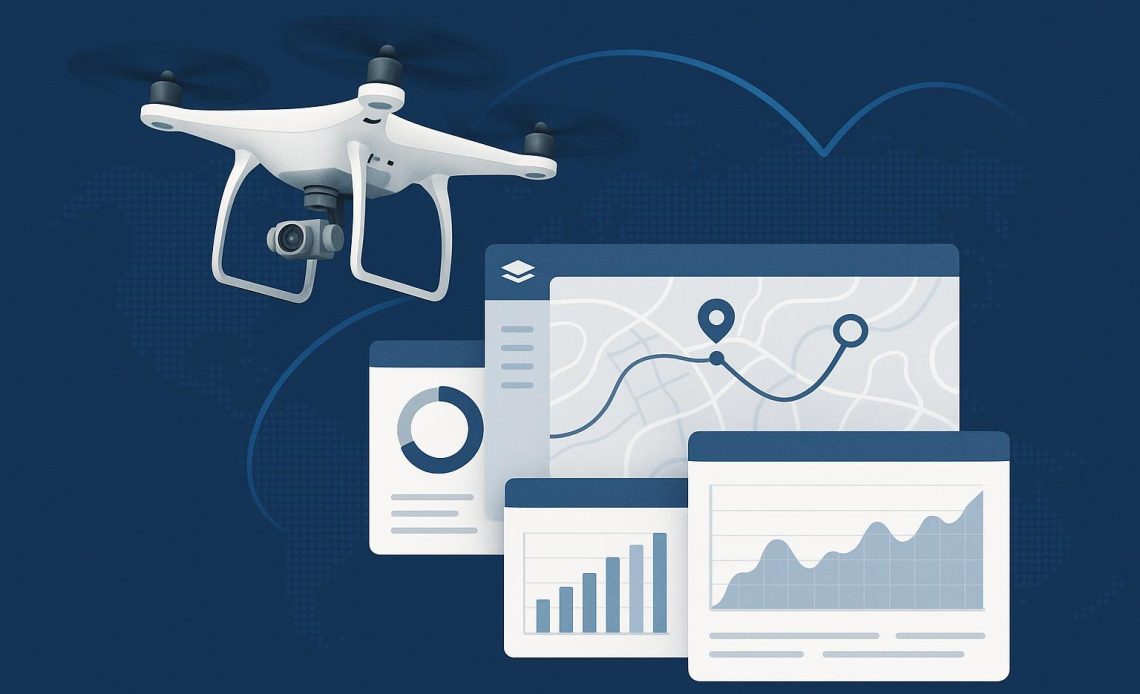
A commercial drone lifts off, does its work, and lands twenty minutes later. To anyone watching, that’s the whole event. Inside the company that flew it, the flight has just produced a small pile of data that somebody now has to name, sort, and file. Telemetry from the aircraft. A flight record from the pilot. Notes from the ground crew. Whatever the drone was sent up to capture in the first place. For a business that runs these flights all day, the flying is routine. Keeping the data trail behind it coherent is the part that quietly eats time.
That trail matters because other people ask to see pieces of it later, usually with a deadline attached. A client wants proof the flight was insured and flown by a certified pilot. An insurer wants the incident history before a renewal. A regulator wants to know the aircraft was registered and the airspace was cleared. Answering any of them means finding records that, in a lot of operations, live in five different places. That’s why a growing number of teams have consolidated the whole trail into drone management software like FlybyOps, rather than leaving it scattered across an SD card, a phone, a shared drive, and a group chat. This piece looks at what that data really is, where it tends to end up, and why keeping it in order gets harder as a program grows.
What a single flight produces
Most of the data starts on the drone itself. Modern aircraft log their own telemetry continuously: position, altitude, speed, battery voltage, signal strength, and more, all recorded second by second and available to replay after the fact. On top of that, since 2024 most registered drones in the US have to broadcast Remote ID, a signal that carries the aircraft’s identity and location while it flies, which means the drone is putting out identifying data the moment it leaves the ground. None of that is the deliverable. It’s the exhaust from the flight, and it can matter a great deal if anyone ever questions what happened.
Then there’s the human record. The pilot closes out a flight log with the date, location, aircraft, duration, payload, and anything unusual that came up. The ground crew may note weather shifts, a curious bystander at the perimeter, or a delay while a manned helicopter passed overhead. If the job was an inspection or a survey, the actual output, the imagery or the model, gets processed in separate mapping software and handed to the client. All of this sits alongside a second layer of records that has nothing to do with the flight path: the aircraft’s maintenance history, the risk assessment written before takeoff, an incident report if something went wrong, and the permits, insurance certificates, and confidentiality agreements the job required.
Where the data usually ends up
Left to its own devices, this is where the trail fragments. The telemetry stays on a memory card or in the drone manufacturer’s app. The imagery goes into the mapping tool. The flight log lands in a spreadsheet, or on the pilot’s laptop, or nowhere. Permits and insurance PDFs sit in a shared folder that three people have edit access to. The incident report gets typed into a group chat and scrolls away by the following week. Each tool does its own small job well enough. The problem shows up when someone needs the full picture of one flight and has to reassemble it from half a dozen sources that were never designed to talk to each other.
For a solo operator running the occasional job, that reassembly is annoying but survivable. The strain grows with volume. A utility flying hundreds of inspections a month can’t reconstruct any single one from memory, and it shouldn’t have to open four apps to find out who flew a particular tower and whether the aircraft was due for service that week. There’s more to a single record than tidiness. It lets you answer a specific question about a specific flight, months later, without a search party.
Why scattered data turns into a real problem
Three pressures turn a messy data trail from a nuisance into a liability. The first is proof. When a regulator or an auditor comes asking, an operation that can produce a clean, complete record of a flight is in a very different position than one still hunting for the risk assessment. The second is confidentiality. A firm working for competing clients, or on sensitive sites, often signs agreements that require one client’s data to stay invisible to anyone working another client’s job. A shared drive doesn’t enforce that. A pilot with folder access can browse anything in it.
The third pressure is trust in the record itself. Having a flight log is one thing; being able to show that the log wasn’t quietly edited after an incident is another. That is why serious operations now pay attention to how their records are stored. A history that captures every change, tied to a person and a timestamp, and that can’t be rewritten after the fact, carries far more weight in a dispute than a spreadsheet anyone could have altered the night before. A record only helps if it can be trusted, and trust comes from how it is kept.
What changes when a program scales
A single pilot with a notebook and a cloud folder can run a clean operation for one client. The math changes fast with growth. Add pilots and the team needs to know who flew what, which a shared sheet handles poorly the instant two people open it. Add clients and the confidentiality problem becomes real, because people should see the jobs they are assigned to and not the rest. Let a few years pass and the oldest records start to matter most, right when they are hardest to find, because the sheet holding them has been overwritten more times than anyone tracked.
Staff turnover is the quiet multiplier. When the person who set up the folder structure leaves, their replacement inherits filenames and conventions nobody wrote down. This is the point at which many programs stop treating the data trail as a pile of separate tools and start treating it as one operational record, with defined roles for who can see what and a history that holds up under scrutiny. The software is just the means. The goal is being able to stand behind any flight the company has ever run, and a coherent record is what makes that possible.
FAQ
What data does a commercial drone actually collect?
A typical flight generates onboard telemetry (position, altitude, speed, battery, signal), a broadcast Remote ID signal identifying the aircraft in flight, a pilot flight log, any imagery or mapping data the job called for, and surrounding records like maintenance history, risk assessments, and incident reports.
Do drone operators have to keep all of this data?
Not every byte, but commercial operators must be able to prove compliance, which means retaining pilot credentials, registration, Remote ID details, airspace authorizations, and flight records when they are relevant. Many teams keep more than the minimum because clients and insurers ask for it, and reconstructing it later is painful.
What is Remote ID, and is it part of the data trail?
Remote ID is an FAA requirement for most registered drones to broadcast their identity and location during flight, a bit like a digital license plate. It became mandatory in 2024. It is one more stream of flight data operators need to account for and, in practice, keep track of alongside the rest.
Why not just keep everything in a shared drive?
A shared drive stores files but doesn’t control who sees what, and it doesn’t record who changed a document or when. For operators handling multiple clients or sensitive sites, both of those gaps matter, which is why many move to a system that enforces access and keeps a tamper-evident history.
How do smaller operators handle their data without a big platform?
Plenty run well on spreadsheets and folders while they are small and serving one client. The usual trigger for a change is a second pilot, a second client whose data has to stay separate, or an old record that turns out to be nearly impossible to find when someone finally asks for it.
The part nobody sees
The visible part of a commercial drone program is a few minutes of flight. The durable part is everything the flight leaves behind, spread across the aircraft, the pilot, the crew, and a stack of documents that outlives the job by years. As the industry grows up, operators are learning that the flight is the easy thing to get right. The record is what clients, insurers, and regulators end up judging them on, and it is worth building with the same care that goes into the flying itself.