
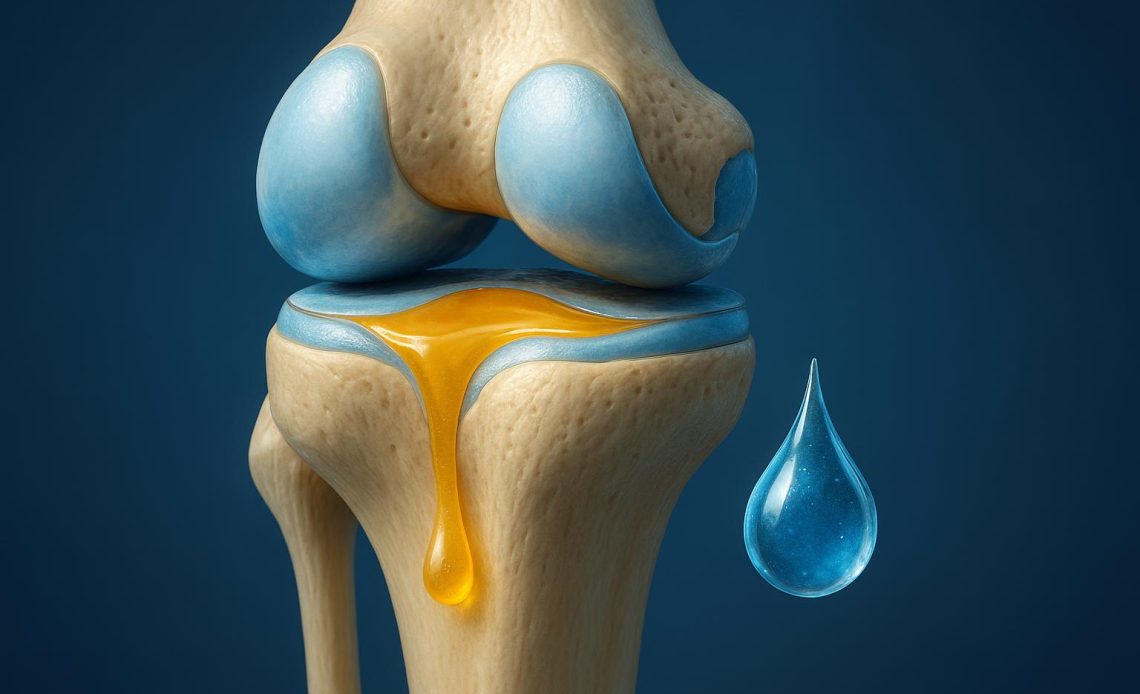
Synovial joints are marvels of mechanical efficiency. Under physiological conditions, healthy articular cartilage glies against itself with a friction coefficient lower than ice on ice. This remarkable fluid-film lubrication relies entirely on the delicate tribological balance of synovial fluid—a complex biological lubricant that transitions continuously between a viscous fluid and an elastic shock absorber depending on the physical forces applied to it.
When osteoarthritis disrupts this system, the mechanical degradation is immediate and punishing. Cartilage doesn’t simply wear down; the fluid bathing the entire joint space loses its structural integrity. Understanding how intra-articular sodium hyaluronate therapy restores this environment requires diving into the physical fluid mechanics of the joint and analyzing how molecular weight and chemical structure influence clinical outcomes.
The Rheology of Native Synovial Fluid
Rheology—the study of how matter flows and deforms—is central to understanding joint health. Synovial fluid is non-Newtonian, meaning its viscosity is not constant. Instead, it exhibits pronounced shear-thinning (pseudoplastic) and viscoelastic behavior, governed primarily by native high-molecular-weight hyaluronic acid (HA) synthesized by specialized type B synoviocytes.
In a normal joint, native HA exists at a concentration of approximately 2.5 to 4.0 mg/mL, boasting an average molecular weight between 4 and 7 Megadaltons (MDa). The physical behavior of this unbranched glycosaminoglycan shifts dynamically based on joint movement velocity:
- Low Shear Rates (Resting, Standing, Slow Walking): At low velocity, long-chain HA molecules form an entangled, random-coil network. This structure traps water, providing high zero-shear viscosity. The fluid forms a protective film between cartilage surfaces, preventing direct contact under static loads.
- High Shear Rates (Running, Impact, Rapid Direction Changes): As shear rate increases, the tangled molecular chains line up parallel to the direction of movement. Viscosity drops dramatically, while the fluid’s elastic modulus ($G’$) surpasses its viscous modulus ($G”$). The fluid acts like a hydraulic spring, dissipating energy and shielding the subchondral bone from high-impact forces.
In osteoarthritic joints, inflammatory cytokines like interleukin-1 beta (IL-1β) and tumor necrosis factor-alpha (TNF-α) trigger a destructive cascade. Reactive oxygen species cleave native HA chains, while increased vascular permeability causes joint effusion, diluting the remaining fluid.
The average molecular weight of HA in an osteoarthritic joint drops to between 1.0 and 2.0 MDa, with concentrations falling by up to 50%. The fluid shifts from a protective viscoelastic gel to a thin, watery liquid incapable of sustaining fluid-film lubrication under load.
Boundary Lubrication and Chondrocyte Protection
When fluid-film lubrication fails, joint integrity depends on boundary lubrication—a mechanism operating directly at the superficial cartilage surface. Here, specialized molecules prevent direct, abrasive tissue-to-tissue contact.
The articular cartilage superficial zone is rich in lubricin (a surface-zone proteoglycan) and specialized pericellular matrix components that interact directly with sodium hyaluronate. In healthy joints, HA forms a protective boundary layer anchored to the pericellular matrix of superficial chondrocytes via CD44 transmembrane receptors.
When this boundary layer breaks down, mechanical shear stresses act directly on vulnerable chondrocytes. Mechanical deformation triggers cell apoptosis, stimulates the release of matrix metalloproteinases (MMPs), and accelerates the degradation of type II collagen and aggrecan. Replacing depleted hyaluronan isn’t just about slipping a mechanical lubricant into a dry hinge; it’s about insulating sensitive cartilage cells from shearing forces that drive cell death.
Viscosupplementation: Restoring Mechanics with Exogenous Hyaluronan
Re-establishing joint mechanics requires introducing exogenous hyaluronic acid with sufficient molecular weight and purity to restore native rheology. Viscosupplementation works by elevating intra-articular viscosity, restoring shock absorption, and reducing friction coefficients across articular surfaces.
However, clinical success depends heavily on the properties of the chosen formulation. Practitioners face distinct choices between heavily crosslinked hydrogels and highly purified, non-crosslinked sodium hyaluronate options. While synthetic crosslinking extends the residence time of the fluid within the joint cavity, it can alter the fluid’s shear-thinning response and, in some patients, provoke localized inflammatory reactions or pseudoseptic flares.
Conversely, non-crosslinked formulations derived from biological fermentation or avian sources replicate native fluid dynamics without altering the natural chemical backbone of the molecule.
When sourcing treatments for clinical practice, evaluating molecular purity, source origin, and rheological parameters becomes essential. For orthopedic specialists seeking validated options, the ability to buy Supartz online offers access to a highly purified, non-crosslinked sodium hyaluronate solution with a established track record in mild-to-moderate knee osteoarthritis. Clinicians can review specific molecular weight profiles, multi-dose treatment protocols, and safety data to ensure alignment with individual patient pathology.
Beyond pure fluid mechanics, exogenous sodium hyaluronate provides important biological signaling. When injected HA binds to CD44 receptors on synoviocytes, it suppresses down-stream inflammatory pathways, inhibits MMP-1, MMP-3, and MMP-13 production, and encourages endogenous synthesis of high-molecular-weight HA by native synoviocytes.
This dual action—immediate mechanical cushioning followed by sustained biological modulation—explains why clinical benefit often outlasts the physical clearance of the injected fluid from the joint space.
Decision Framework: Evaluating Hyaluronic Acid Formulations
Choosing an appropriate intra-articular agent requires balancing rheological behavior, residence time, injection frequency, and safety profiles. The decision matrix below outlines key differences across major categories of viscosupplements.
| Formulation Parameter | Low Molecular Weight (0.5 – 1.2 MDa) | Mid-to-High MW Non-Crosslinked (2.5 – 5.0 MDa) | Crosslinked Hydrogels (Residue-Modified) |
| Primary Mechanism | CD44 cellular binding, endogenous HA stimulation | Fluid-film restoration, shock absorption, biological signaling | Physical space-filling, extended mechanical residence |
| Elastic Modulus ($G’$) | Low elasticity under dynamic stress | High elastic retention matching native joint fluid | Very high, rigid structural elasticity |
| Shear-Thinning Response | Minimal | High (adapts dynamically to load velocity) | Fixed/altered flow properties |
| Typical Treatment Protocol | 3 to 5 weekly injections | 3 to 5 weekly injections | 1 single injection |
| Joint Residence Time | ~12 to 24 hours | ~24 to 48 hours | Several days to weeks |
| Local Reactivity Risk | Very low | Very low (minimal immunogenic profile) | Higher risk of transient post-injection flare |
| Ideal Clinical Candidate | Early-stage OA with mild inflammation | Moderate OA (KL Grade II–III) with high functional demands | Patients with poor compliance for multi-dose series |
Common Mistakes in Intra-Articular Therapy Selection
Even with high-quality sodium hyaluronate, clinical outcomes vary based on technique and patient selection. Avoiding common missteps helps maximize therapeutic benefit:
- Injecting into an Active, Effused Joint: Injecting hyaluronan into a joint swollen with inflammatory effusion dilutes the product instantly. The excess fluid lowers viscosity, increases shear stress, and accelerates lymphatic clearance. Always perform complete arthrocentesis prior to delivering the viscosupplement.
- Ignoring Joint Alignment and Biomechanics: Viscosupplementation restores fluid dynamics, but it cannot override severe mechanical malalignment (e.g., severe varus or valgus deformities). Combining intra-articular therapy with unloader bracing or physical therapy yields significantly better functional scores than monotherapy.
- Misjudging Disease Severity: Administering HA to a patient with Kellgren-Lawrence Grade IV osteoarthritis—where articular cartilage is completely denuded—rarely delivers satisfactory results. Without functioning cartilage or superficial-zone chondrocytes, boundary lubrication mechanisms cannot operate effectively.
- Neglecting Post-Injection Activity Modification: Allowing patients to engage in heavy, high-impact weight-bearing exercise immediately after injection increases intra-articular pressure and accelerates lymphatic clearance of the formulation.
Practical Application and Patient Selection
Identifying the right candidate for sodium hyaluronate therapy requires thorough clinical and radiographic assessment. Patients with symptomatic Kellgren-Lawrence Grade II or III knee osteoarthritis who have failed conservative first-line therapies (such as activity modification, physical therapy, and acetaminophen or NSAIDs) represent the primary treatment population.
[ Patient Assessment ]
│
├─► Kellgren-Lawrence Grade I/IV ──► Consider alternative interventions
│
└─► Kellgren-Lawrence Grade II/III
│
├─► Active Effusion Present? ──► Perform Arthrocentesis First
│
└─► No Effusion / Post-Aspiration
│
▼
[ Administer Viscosupplement ]
│
▼
[ 48-Hour Impact Activity Rest ]
Following injection, advise patients to avoid prolonged standing, running, or heavy lifting for 48 hours. This transient period of reduced mechanical stress allows the hyaluronan to distribute evenly across the articular surfaces and anchor to the cartilage matrix, maximizing both mechanical boundary protection and cellular signaling pathways.
Long-Term Joint Preservation Strategies
Managing osteoarthritic joint mechanics requires a comprehensive approach. Viscosupplementation with purified sodium hyaluronate provides a powerful, non-surgical tool to restore rheological balance, reduce joint friction, and protect chondrocytes from mechanical shear.
When integrated thoughtfully alongside weight management, functional biomechanical rehabilitation, and targeted joint unloading, intra-articular therapy helps bridge the clinical gap between early conservative management and invasive surgical reconstruction.