
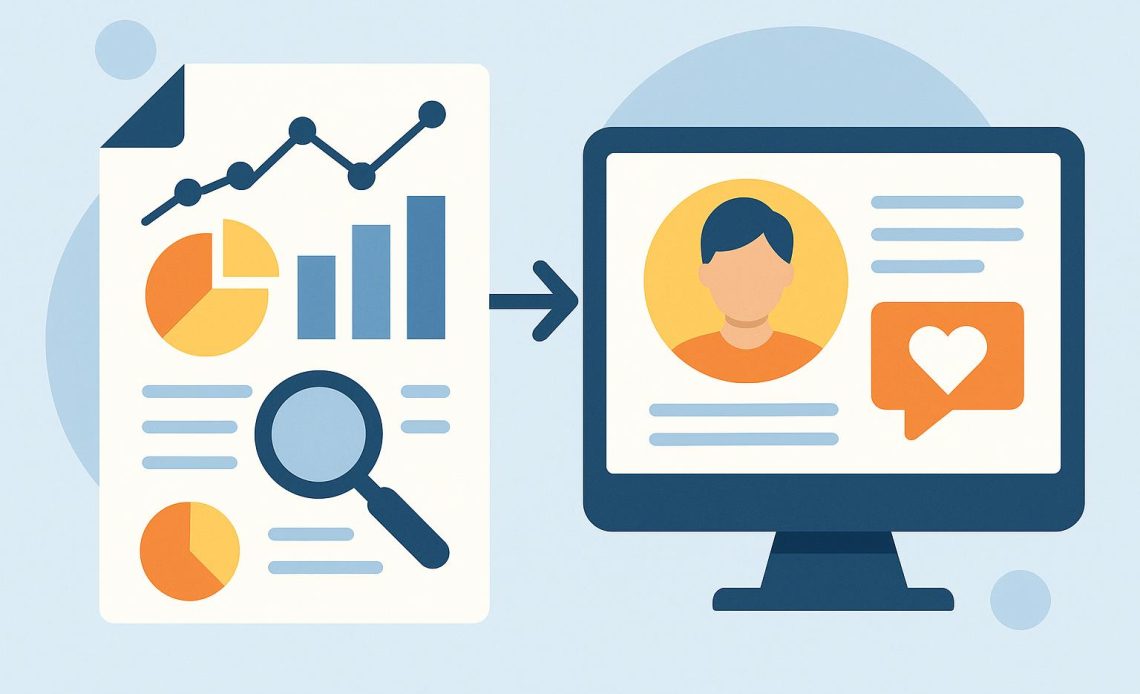
In today’s digital landscape, organizations have access to more data than ever before. Every click, scroll, search, and interaction can be tracked, measured, and visualized through sophisticated analytics platforms. Dashboards are full of numbers, conversion funnels are mapped in detail, and behavioural metrics update in real time. Yet despite this abundance of information, many product and marketing teams still struggle to answer a simple question: Who are we really building for?
The paradox is clear. Companies are data-rich but often insight-poor. They know what users do, but not always why they do it. They can see where users drop off, but not what motivates them. This gap between quantitative data and human understanding is where user personas play a critical role. To move from raw analytics to meaningful product decisions, teams need structured ways to interpret and humanize data. Tools like a well-designed User Persona Template help transform scattered information into clear, actionable user profiles that guide strategy, design, and execution across the organization.
THE LIMITS OF DATA WITHOUT CONTEXT
Data is invaluable, but it rarely tells the full story on its own. Metrics can reveal pattern (such as high bounce rates or low conversion rates) but they cannot fully explain the motivations, frustrations, or expectations behind user behaviour.
For example, analytics might show that users abandon a checkout page at a specific step. But is the issue pricing, usability, trust, or confusion about the product? Without context, teams risk making assumptions that lead to ineffective solutions. They might redesign a page, adjust pricing, or add features without addressing the underlying problem. This is where empathy becomes a strategic advantage. Understanding the user’s perspective allows teams to interpret data correctly and make decisions that resonate with real needs rather than abstract metrics.
BRIDGING THE GAP BETWEEN NUMBERS AND PEOPLE
User personas serve as a bridge between data and empathy. Rather than relying solely on demographic information or surface-level insights, modern personas integrate behavioural patterns, goals, challenges, and motivations. When built correctly, personas answer key questions such as:
- What problems is this user trying to solve?
- What drives their decision-making?
- What obstacles do they encounter?
- How do they interact with digital products in their daily life?
By synthesizing data into relatable profiles, personas make users tangible. Instead of discussing “traffic” or “segments,” teams begin to talk about real individuals with specific needs. This shift in perspective can fundamentally change how decisions are made.
FROM DASHBOARDS TO DECISIONS
Many organizations invest heavily in analytics tools but struggle to translate insights into action. Data often remains siloed within marketing or analytics teams, disconnected from product development or design processes. A structured persona framework helps break down these silos. When personas are shared across teams, they become a common reference point for decision-making. Product managers use them to prioritize features. Designers use them to shape user journeys. Marketers use them to craft messaging that resonates. This alignment ensures that decisions are not made in isolation. Instead, they are grounded in a shared understanding of the user. Using a structured User Persona Template early in the process allows teams to capture insights consistently, ensuring that every persona reflects both data-driven evidence and qualitative understanding.
TURNING INSIGHTS INTO PRODUCT IMPROVEMENTS
One of the most powerful aspects of user personas is their ability to guide product evolution. When teams clearly understand who they are designing for, they can focus on features and experiences that deliver real value. Consider a SaaS platform with declining engagement. Analytics may reveal that users sign up but fail to adopt key features. By developing detailed personas, the team might discover that onboarding is too complex for first-time users, or that advanced features are not aligned with their primary goals. Armed with this insight, the team can redesign onboarding flows, simplify interfaces, and introduce targeted guidance. This approach ensures that product improvements are not based on guesswork but on genuine user understanding.
THE ROLE OF PERSONAS IN CONVERSION AND RETENTION
Beyond product development, personas play a crucial role in marketing performance and customer retention. Understanding user motivations allows teams to craft messaging that speaks directly to their needs and expectations. For example, a persona focused on efficiency may respond to messaging that highlights time-saving features, while another persona driven by innovation may be more interested in advanced capabilities. Tailoring communication to these motivations improves engagement and conversion rates. Retention also benefits from persona-driven strategies. When users feel understood and supported, they are more likely to remain loyal. Personas help teams anticipate user needs and deliver experiences that build long-term relationships.
AVOIDING COMMON PERSONA PITFALLS
Despite their value, personas are sometimes dismissed as superficial or outdated. This often happens when they are created without sufficient data or treated as static documents rather than living tools. Effective personas should:
- Be grounded in real data and research
- Reflect behavioural insights, not just demographics
- Be updated as user needs evolve
- Be integrated into everyday workflows
Using a structured template helps ensure consistency and relevance. It provides a clear framework for capturing insights and keeping personas aligned with current user realities.
CREATING A CULTURE OF USER UNDERSTANDING
The true power of user personas lies in their ability to foster a culture of empathy within organizations. When teams consistently refer to personas, they begin to think in terms of user outcomes rather than internal assumptions. This cultural shift has far-reaching benefits. Meetings become more focused, debates more constructive, and decisions more aligned with user value. Instead of asking, “What should we build next?” teams ask, “What would help our users succeed?” Such a mindset not only improves product quality but also strengthens collaboration across departments.
FROM DATA OVERLOAD TO MEANINGFUL INSIGHT
As digital ecosystems continue to generate vast amounts of data, the challenge for organizations is no longer collecting information: it is making sense of it. User personas provide the structure needed to transform data into meaningful insights and actionable strategies. By combining analytics with empathy, teams can move beyond reactive decision-making and build products that truly serve their users. Structured tools like this User Persona Template from Craft.io make this process scalable and repeatable, ensuring that user understanding remains at the heart of every decision.
CONCLUSION: DESIGNING WITH UNDERSTANDING, NOT ASSUMPTIONS
In an age defined by data, empathy may seem like a soft skill. Instead, it is a strategic necessity. The most successful products are not those with the most features, but those that solve real problems for real people. User personas enable teams to see beyond numbers and connect with the human stories behind them. They turn analytics into understanding and understanding into better decisions. As organizations continue to navigate increasingly complex digital environments, the ability to transform data into empathy will remain one of the most powerful competitive advantages.